
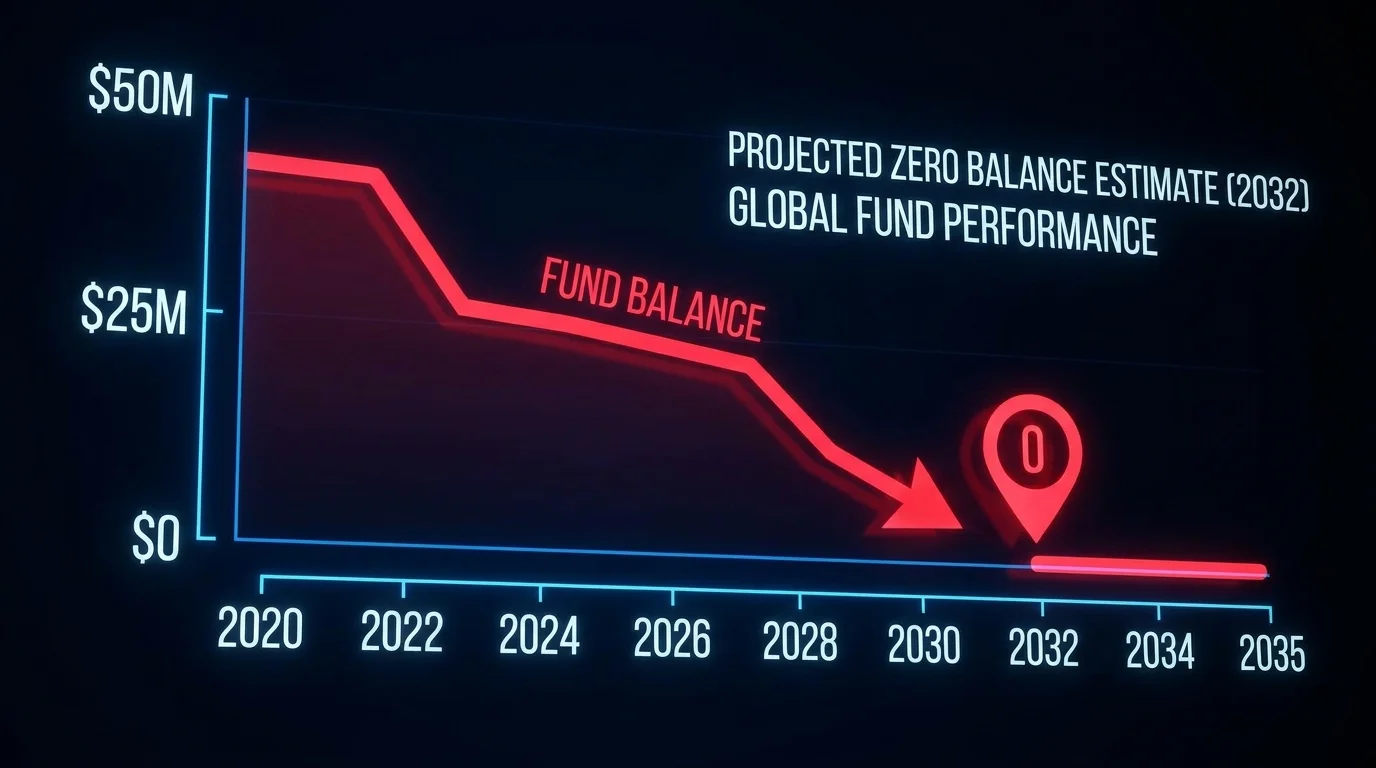
There is a number bouncing around Washington right now that every American within twenty years of retirement should understand: 2032. That is the year the Congressional Budget Office now projects the Social Security Old-Age and Survivors Insurance (OASI) trust fund will reach zero — one year sooner than the estimate that was on the table just twelve months ago.
When a headline says "Social Security is running out of money," most people either dismiss it as political noise or spiral into quiet panic about their retirement. Neither response is useful. What is useful is understanding the actual mechanics of what happens when a trust fund is depleted, what it means for your monthly check, and — perhaps more importantly — what you can do about it right now while you still have time.
I spent eight years working with high-net-worth clients on retirement and portfolio planning before I started writing about personal finance. In that time, I noticed something consistent: the people who panicked about financial headlines rarely made better decisions because of them. The people who slowed down, understood the math, and made deliberate adjustments did. That is what this article is for.
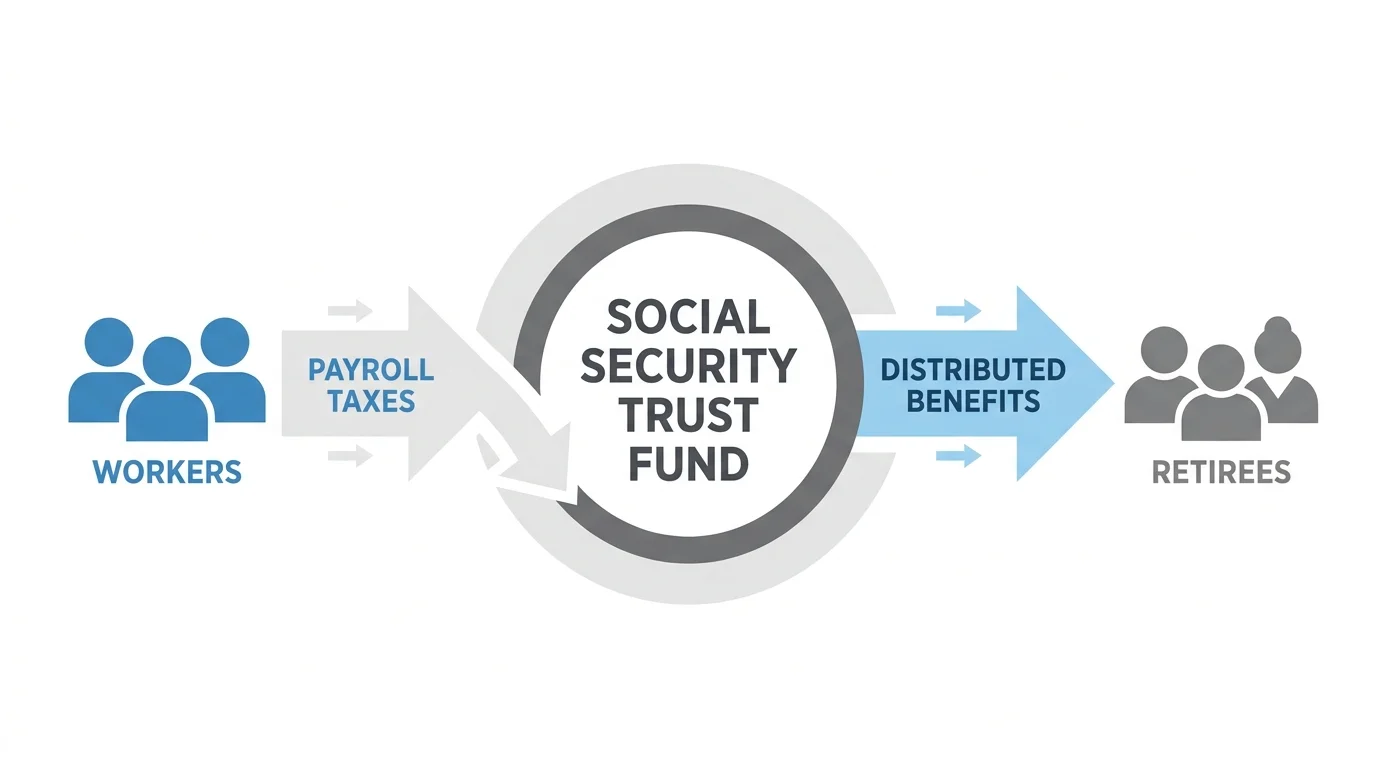
Social Security operates through a relatively straightforward funding mechanism. Workers and employers each pay 6.2% of wages in payroll taxes — 12.4% combined — into the system. Those contributions are supposed to fund benefits for current retirees and survivors.
For decades, Social Security ran surpluses. More money came in than went out, because the workforce was large relative to the retired population. Those surpluses did not sit in a vault somewhere — they were invested in U.S. Treasury bonds held in the trust fund, and they earned interest. The trust fund is not some separate pile of cash reserved for individuals. It is a reserve pool that the system draws down when annual revenues fall short of annual benefit payments.
That shortfall began in 2021. Every year since then, the Social Security Administration has had to redeem trust fund securities to cover the gap between what payroll taxes bring in and what it pays out. The gap is getting wider, not narrower — and for reasons that are not going away.
Why Is the Trust Fund Depleting Faster Than Expected?
Three structural forces are driving this, and they compound one another.
An aging population that is living longer. Baby boomers are retiring at a pace that has not been seen in American history. About 10,000 Americans turn 65 every single day. As the number of beneficiaries rises, the system has to pay out more, even before considering cost-of-living adjustments.
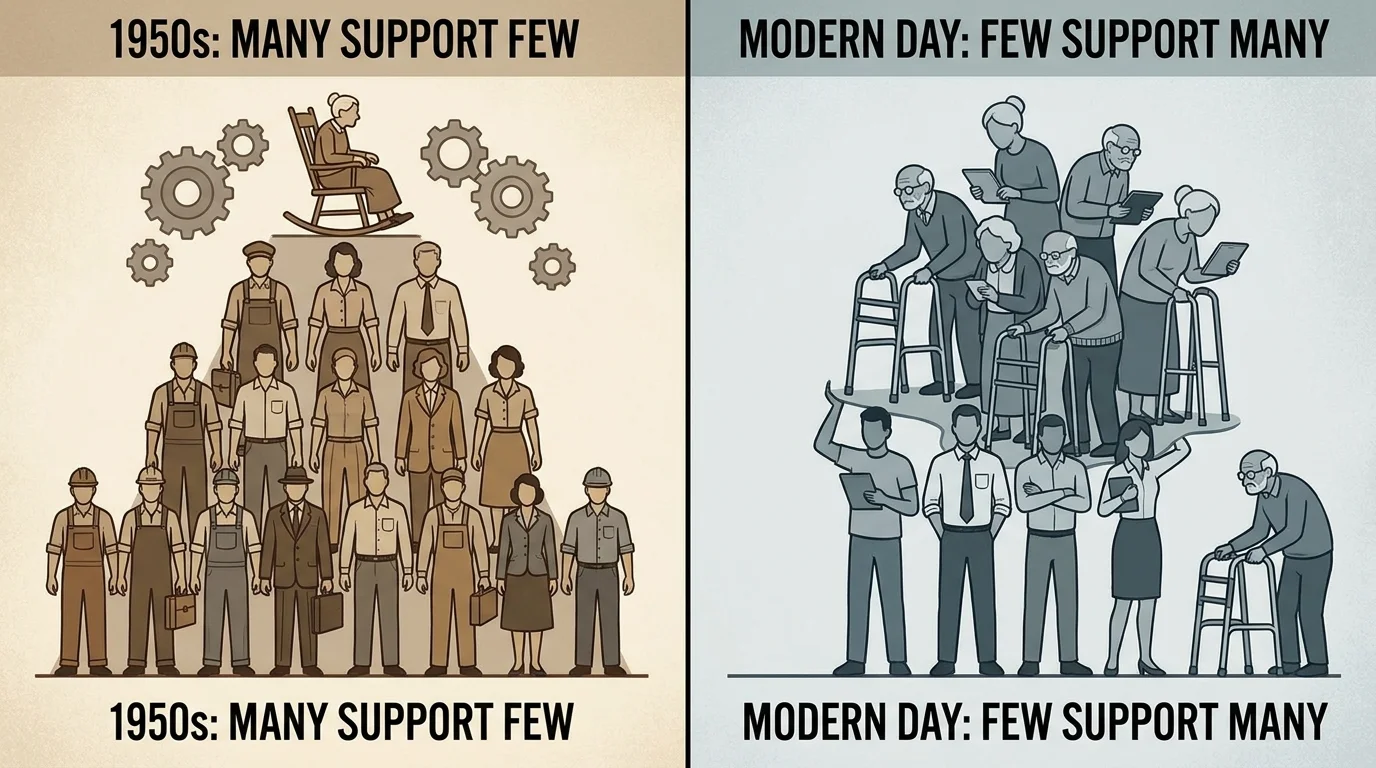 A shrinking ratio of workers to retirees. In 1950, there were roughly 16 workers paying into Social Security for every one beneficiary collecting from it. That ratio has fallen to about 2.7 workers per beneficiary today, and demographic trends suggest it will continue declining. The system was designed in a different era, and the math has never been properly updated to reflect how dramatically that ratio has changed.
Slower economic growth reducing payroll tax inflows. Real GDP growth slowed to 1.4% in the fourth quarter of 2025. A softer labor market and slower economic activity mean fewer wages are subject to payroll taxes, which is precisely the wrong environment for a trust fund that depends on that revenue.
There is also a more recent accelerant. The Social Security Fairness Act added roughly $17 billion in retroactive benefit payments, and a proposed $6,000 tax deduction designed to exempt most seniors from paying taxes on their Social Security benefits would remove a meaningful revenue stream that the program relies on. These changes, while politically popular, have shortened the timeline.
The CBO's February 2026 update moved the OASI depletion date from 2033 to 2032. The Penn Wharton Budget Model confirms this independently. The trajectory is moving in one direction.
What "Depletion" Actually Means — and What It Does Not

This is the part that most coverage gets wrong, and it matters enormously.
When the trust fund is depleted, Social Security does not stop. The program does not shut down. Checks do not go to zero.
What happens is this: the Social Security Administration can no longer draw on the trust fund reserves to supplement incoming revenue. It can only pay out what it takes in — from payroll taxes and the taxes applied to benefits — in real time. Under current law, that triggers an automatic, across-the-board reduction in benefits for every beneficiary.
The CBO's illustrative scenario projects that benefits would be cut by approximately 7% in 2032, deepening to an average of 28% per year from 2033 through 2036. The Committee for a Responsible Federal Budget estimates that once insolvency hits, payable benefits would cover about 77% of what is currently scheduled — meaning a roughly 23% reduction for everyone, regardless of age, income level, or how many years they have paid into the system.
To put concrete numbers to this: the average Social Security retirement benefit in 2026 is approximately $2,071 per month. A 23–28% cut would reduce that to somewhere between $1,491 and $1,595. A typical dual-earning couple could see their combined annual benefits shrink by roughly $18,400, according to CRFB estimates.
These are not edge cases. They are the projected outcome under current law if Congress does nothing.
Who Would Be Most Affected?

Not all retirees are equally exposed to this risk. The impact depends heavily on how dependent you are on Social Security as a share of your overall retirement income.
Current retirees (ages 70 and older): Cuts, if they come, would be immediate and uniform. There is no protected class. A person who has been collecting benefits for a decade faces the same percentage reduction as someone who just filed.
Near-retirees (ages 58–68): This is arguably the group that needs to think most carefully right now. If you plan to retire between 2028 and 2033, you will be filing claims right around the period of maximum uncertainty. Decisions about when to claim — and at what amount — interact directly with any potential reduction.
Younger workers (ages 25–50): The math here is more uncertain, but not irrelevant. If Congress acts eventually — and historically it does — the fix will likely involve some combination of reduced benefits for future retirees, higher retirement ages, or higher payroll taxes. Workers have more time to adjust, but the adjustments available to them depend on when and how Congress moves.
Lower-income retirees: This is where the stakes are highest. For roughly 40% of Americans over 65, Social Security accounts for more than 50% of their total income. A 23% cut to your primary income source is not a budgeting inconvenience — it is a genuine financial emergency.
What Congress Can Actually Do — The Menu Is Finite

Fixing Social Security's structural deficit is not a mystery. The levers are well understood. What is missing is political will, not technical knowledge.
Raise or eliminate the payroll tax cap. In 2026, only earnings up to $184,500 are subject to Social Security payroll taxes. High earners pay this tax on a smaller share of their income proportionally than middle-class workers do. Lifting or eliminating the cap entirely would generate significant additional revenue. The tradeoff: benefits for high earners are also calculated based on earnings, so the cap has long been tied to the benefit formula.
Increase the payroll tax rate. The 12.4% combined employer-employee rate has been unchanged since 1990. Even a modest increase of 1–2 percentage points would meaningfully extend the fund's life. The Penn Wharton Budget Model suggests that eliminating the long-range deficit entirely through the payroll tax alone would require raising the rate to roughly 17.15% — a politically steep ask.
Raise the full retirement age. The 1983 Social Security reforms gradually raised the full retirement age from 65 to 67, and that phase-in is now complete. Raising it further — to 68 or 69 — would effectively reduce lifetime benefits for future retirees without cutting monthly checks directly. Given that life expectancy has increased substantially since 1983, this argument has economic logic behind it. It also has real equity concerns, since lower-income workers have not seen the same longevity gains as higher-income workers.
Modify the COLA formula. The current COLA is calculated using the CPI-W (Consumer Price Index for Urban Wage Earners and Clerical Workers). Some proposals would switch to the chained CPI, which accounts for consumer substitution behavior and tends to run slightly lower — meaning slower growth in benefits over time. Others argue for a CPI-E (for the Elderly), which weights healthcare costs more heavily and would typically produce higher COLAs. This is a debate about which direction to pull, not agreement on the formula itself.
Means-testing. Some proposals would reduce or eliminate benefits for high-income retirees on the theory that Social Security should prioritize those who need it most. This is controversial — the program has always been framed as a universal earned benefit, not a welfare program — and high-income earners do pay in significantly throughout their careers.
In practice, any realistic fix will involve some combination of these approaches. The 1983 reforms, the last time Congress actually patched the program in a meaningful way, combined a payroll tax increase, a gradual retirement age increase, and partial taxation of benefits. A similar bipartisan package is possible — but the political environment today is considerably more fractured than it was in 1983.
The 2032 Timeline: Is It Close Enough to Matter to You?
Six years sounds like a long time. In retirement planning, it is not.
If you are 60 today, you will be 66 in 2032 — right at or just past full retirement age. If you are 55, you will be 61. If you are 50, you will be 56. These are all ages where Social Security claiming decisions are still very much on the table, and where the answer to "when should I claim?" may look different depending on whether benefits are cut.
The 2032 date is also not a hard cliff. The trajectory suggests the trust fund balance will be declining visibly for several years before it hits zero. Politicians facing an approaching crisis have both the incentive and the mechanism to act before the automatic cuts kick in. But each year Congress delays, the available options become more disruptive. A 2026 fix looks different from a 2031 emergency patch.
What does this mean practically? It means the window for gradual, less painful adjustments is closing, not opening. And it means that individuals who reduce their dependence on Social Security over the next six years — by building other income sources, optimizing claiming strategy, and stress-testing their retirement plans against a range of benefit scenarios — will be in a materially better position regardless of what Congress ultimately does.
What You Can Do Right Now: A Framework for Real People

I want to be direct here: I am not going to tell you to panic-sell your portfolio, annuitize everything, or make dramatic changes based on a 2032 projection that Congress may fix before it arrives. What I am going to say is that ignoring this entirely is also not the right posture.
Here is a framework for thinking through your personal exposure.
Step 1: Know Your Number
Go to ssa.gov and create a My Social Security account. Pull your earnings record and your estimated benefit at various claiming ages. Most people have not looked at this in years, and the estimate is often meaningfully different from what they assume. That number is your baseline — your current stake in this conversation.
Step 2: Run a Stress Test
Model what your retirement income looks like if Social Security benefits are reduced by 20–25%. This is not a prediction. It is a scenario. A meaningful stress test means asking: could I cover my essential expenses — housing, food, healthcare, utilities — if my Social Security check were smaller? If the answer is no, that is the actual problem to solve.
Step 3: Build Outside Income
Every dollar of retirement income that does not depend on Social Security is a dollar that is not at risk from trust fund depletion. This means 401(k)s, IRAs, Roth IRAs, taxable brokerage accounts, rental income, part-time work, dividends — any source that is yours and not subject to Congress's timeline.
For workers between 60 and 63, the 2026 contribution rules allow catch-up contributions up to $34,750 to a 401(k). That is not an abstraction. That is $34,750 per year in tax-advantaged accumulation that belongs to you unconditionally.
Step 4: Think Carefully About Claiming Age
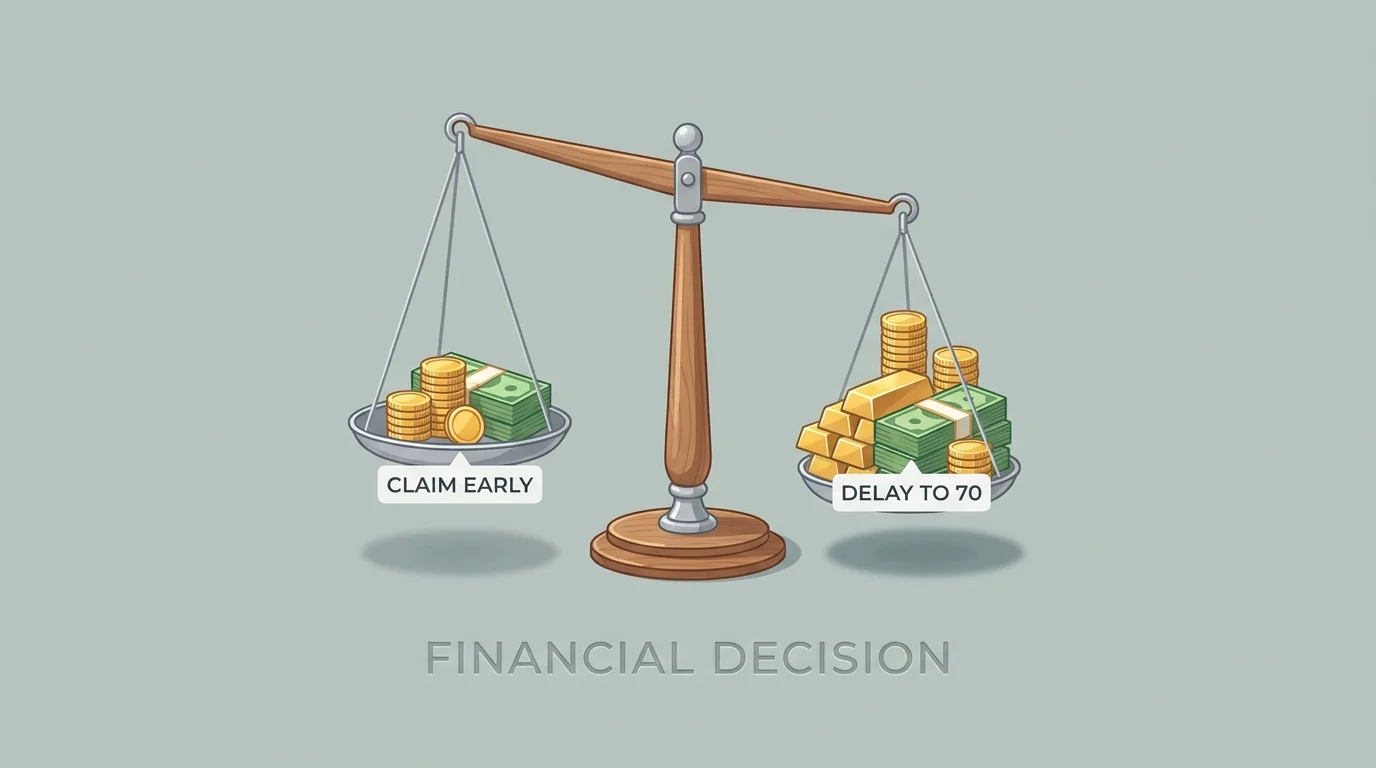
Delaying Social Security past full retirement age increases your monthly benefit by 8% per year up to age 70. A larger base benefit means that even if a 23% cut eventually comes, you are cutting from a higher starting point and landing at a higher absolute number than you would have if you had claimed early.
This dynamic makes delayed claiming more attractive for people with enough other assets to cover living expenses while they wait. The math is not universal — it depends on your health, your other income, your spouse's situation — but the case for delay has gotten incrementally stronger given the trust fund uncertainty.
Step 5: Lower Your Fixed Expenses
This one gets underestimated. A retirement budget with lower mandatory fixed costs — smaller mortgage or no mortgage, lower recurring obligations — requires less income to sustain. If your Social Security benefit shrinks, lower fixed expenses give you more room to absorb that without selling assets into a down market or compromising your lifestyle dramatically.
A Final Word on Congress and Human Nature
Every time Social Security's finances have looked dire in the last half century, Congress has eventually acted. The 1983 reforms happened under Reagan and saved the program for forty years. Legislators on both sides of the aisle understand that Social Security touches more than 70 million current beneficiaries — a constituency large enough to end political careers.
That does not mean Congress will act in time. It does not mean the fix will be fair, or that your benefits will be fully protected. What it means is that the all-or-nothing framing — "Social Security will either be fine or completely gone" — misses the nuance of how these situations actually resolve. What is most likely is some combination of modest benefit adjustments for future retirees and incremental revenue increases, arrived at in a messy, delayed, politically painful way.
Plan for uncertainty. Not for catastrophe, and not for perfect preservation of the current system. The people who come through structural financial shifts like this one in good shape are the ones who reduced their dependence on any single income source, stayed informed without overreacting to individual headlines, and made deliberate decisions while they had time to make them.
You have time. Use it.
Marcus Whitmore is a Staff Writer at RippleThought and a former wealth management analyst. He writes about personal finance without selling anything or making it more complicated than it needs to be. Read more of his work at ripplethought.com/authors/marcus_whitmore.