
Every October, the Social Security Administration announces the following year's cost-of-living adjustment. And every year, tens of millions of retirees run the same quick mental calculation: take the current benefit, add the percentage, get excited.
Then January arrives, and the check is not what they expected.
For the third consecutive year, that disappointment is likely in 2027. Early projections from The Senior Citizens League place the 2027 COLA at 2.8% — the same as 2026. On paper, that sounds reasonable. In practice, for many retirees on Medicare, a meaningful portion of that raise will be absorbed before it ever reaches their bank account.
This article is going to explain exactly how that happens, why it keeps happening, and what — if anything — you can realistically do about it.
What a COLA Is, and What It Is Not
Start with the basics, because the design of the cost-of-living adjustment has real implications for how useful it actually is.
The Social Security Administration calculates the annual COLA by comparing the Consumer Price Index for Urban Wage Earners and Clerical Workers — the CPI-W — across July, August, and September of the current year against the same three months the prior year. The percentage change in that average becomes the COLA applied to benefits starting in January.
In 2026, that calculation produced a 2.8% increase. The average monthly retirement benefit was approximately $2,071 going into the year, so the raise translated to roughly $58 per month in additional income — before accounting for anything else.
The stated purpose of the COLA is to preserve purchasing power. If prices rise by 2.8%, your benefit rises by 2.8%, and theoretically you can buy the same amount of stuff you could before. That is the theory.
There are two significant problems with how it plays out in practice, and both are worth understanding in detail.
Problem One: The Wrong Inflation Measure
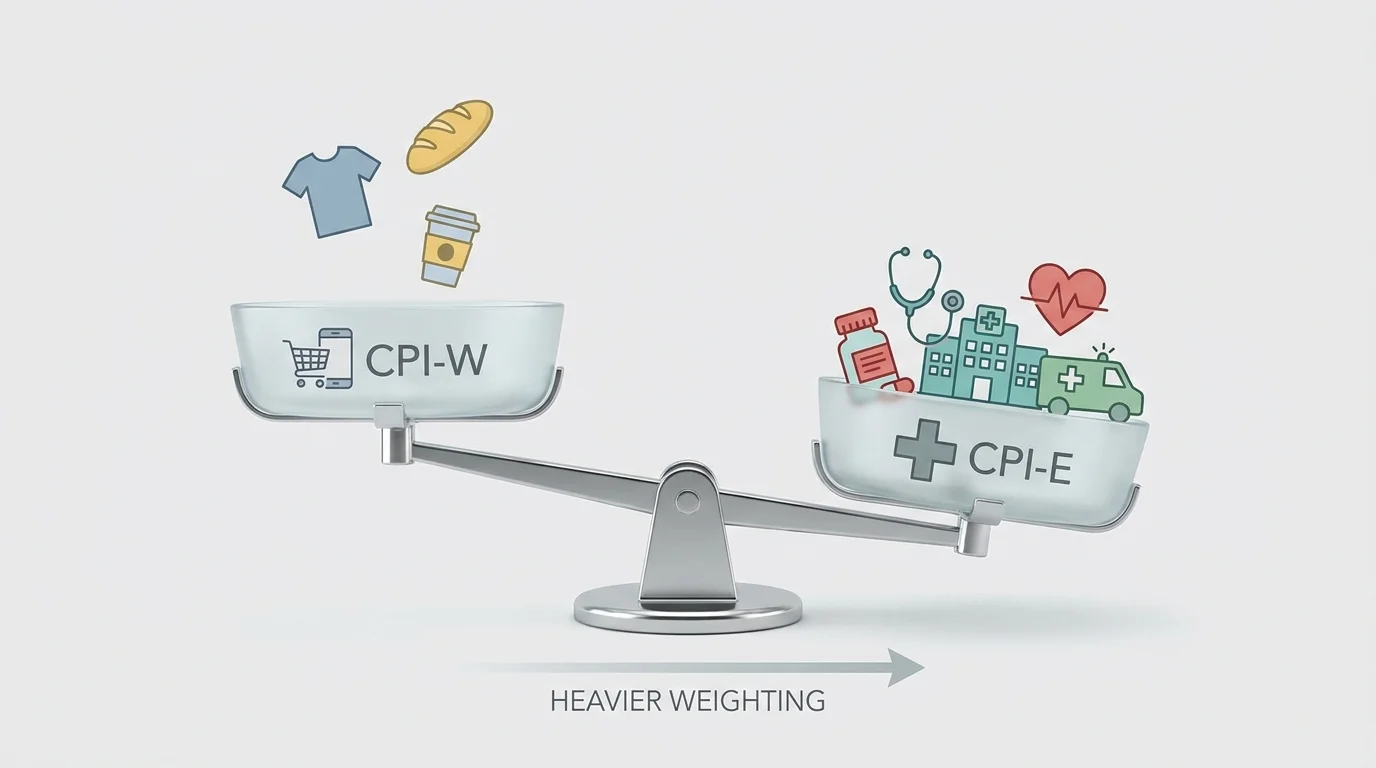
The CPI-W was designed to track price changes for urban wage earners and clerical workers — people who are primarily working-age and still employed. The spending patterns of that group are not identical to the spending patterns of a 72-year-old retiree living primarily on Social Security and Medicare.
Older Americans spend a disproportionately large share of their income on healthcare. The CPI-W does not weight healthcare as heavily as it appears in actual retiree budgets. An alternative measure — the CPI-E, or Consumer Price Index for the Elderly — has been studied for years and consistently shows that the inflation retirees actually experience tends to run higher than what the CPI-W captures.
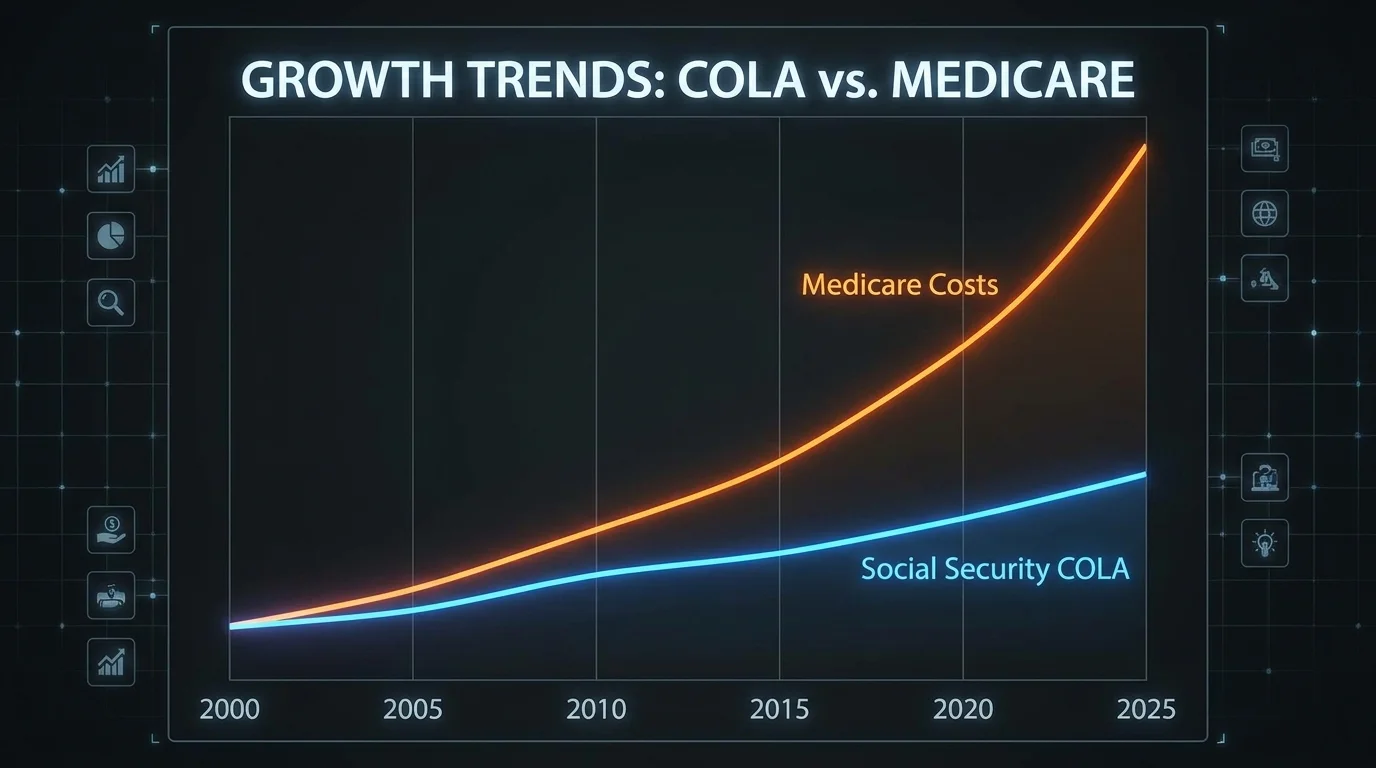
Independent Social Security and Medicare policy analyst Mary Johnson has tracked this data for years. Between 2010 and 2024, she found that Social Security COLAs averaged 2.6% annually, while Medicare Part B premiums rose an average of 5.5% per year. That gap has compounded into a significant erosion of purchasing power. Her research suggests that the buying power of the average Social Security benefit has fallen by approximately 20% since 2010, even accounting for the annual COLA adjustments.
Twenty percent over fourteen years. That is not a rounding error — it is a structural failure of the inflation-indexing mechanism.
Problem Two: Medicare Part B Premiums Coming Out of Your Check
This is where the 2027 situation becomes particularly concrete.
If you receive Social Security benefits and you are enrolled in Medicare — which describes the majority of Social Security recipients over 65 — your Medicare Part B premium is automatically deducted from your monthly check. You never see that money. It goes straight from the Social Security Administration to Medicare on your behalf.
In 2025, the standard Medicare Part B premium was $185 per month. In 2026, it jumped to $202.90 — an increase of $17.90, or roughly 9.7%. That increase did not show up as a separate bill. It came directly out of the Social Security benefit.
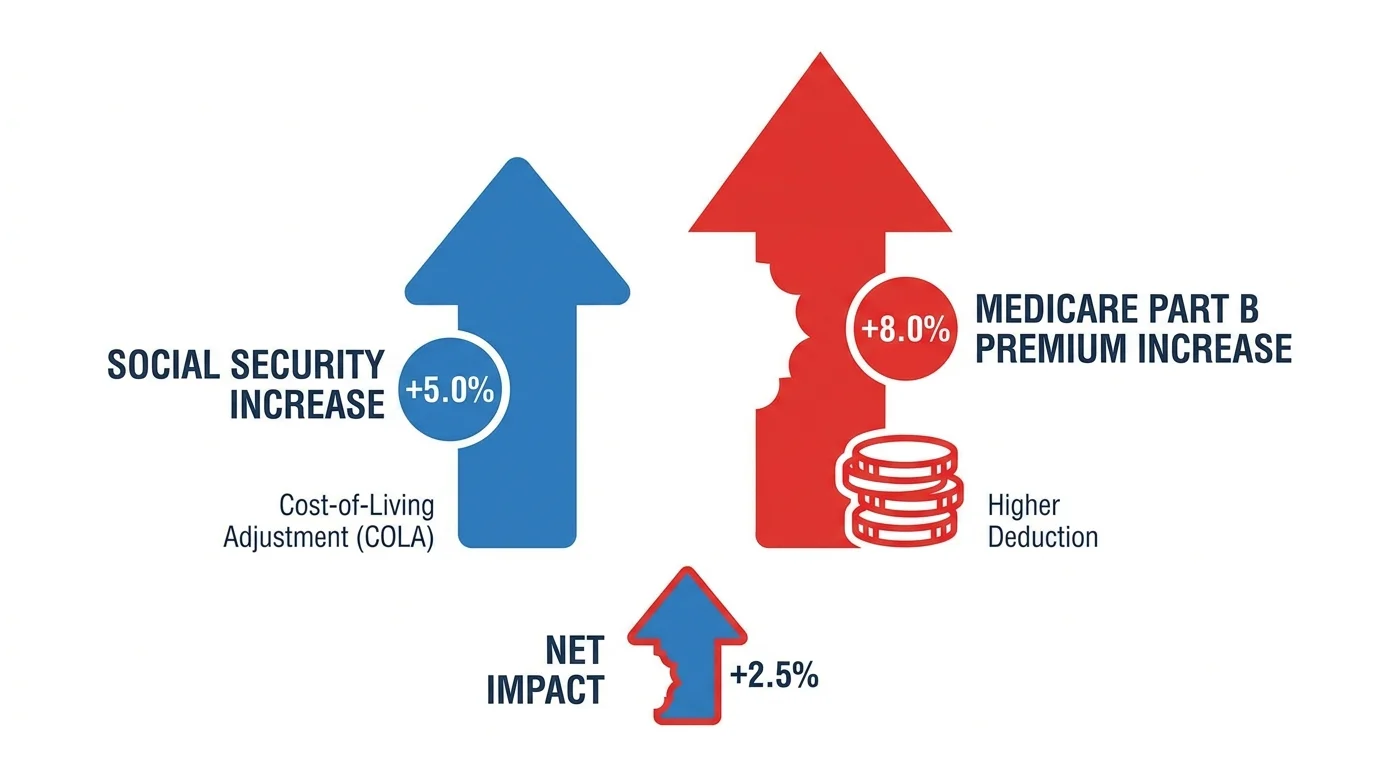
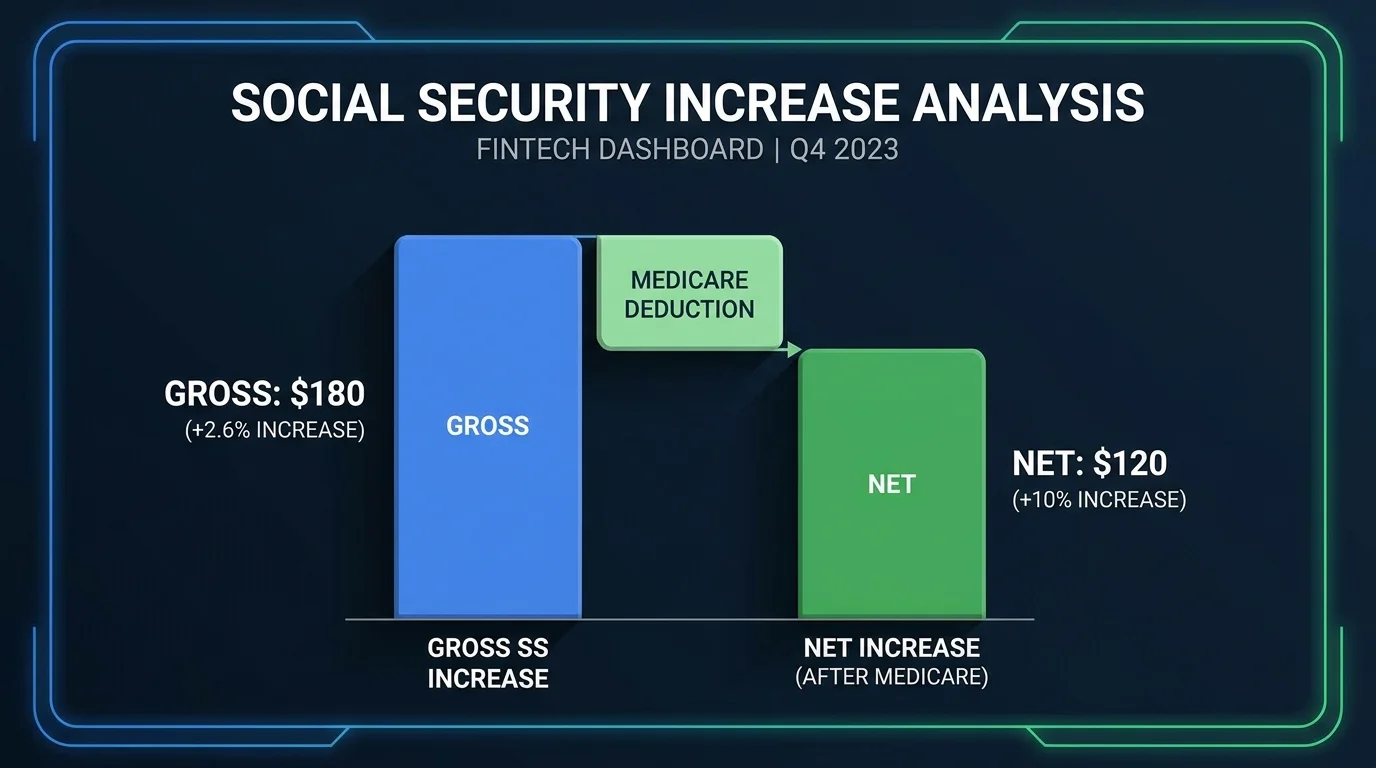
For someone receiving the average 2026 benefit of approximately $2,071 per month, the math breaks down like this: the 2.8% COLA added roughly $58 to the monthly check, while the Medicare Part B increase removed $17.90. The net improvement in actual spendable income: about $40.
Forty dollars per month after waiting a full year for the cost-of-living adjustment. And that assumes the Medicare Part B premium does not rise further in 2027, which is historically unlikely.
This is not a quirk. It is a pattern that has played out repeatedly. The hold-harmless provision in the Social Security Act prevents Medicare from reducing someone's net benefit below what they received the prior year, so extreme Medicare hikes cannot completely zero out a COLA. But a moderate Medicare increase stacked against a moderate COLA leaves many retirees with very little real improvement.
What the Numbers Look Like for 2027
The 2027 COLA will not be finalized until mid-October 2026, when the Social Security Administration announces the official rate based on third-quarter CPI-W data. What we have right now are projections, and those projections are in motion.
As of mid-April 2026, The Senior Citizens League projects a 2027 COLA of 2.8%, matching the 2026 figure. Independent analyst Mary Johnson is projecting a higher figure — currently 3.2% — driven by rising energy prices following geopolitical disruptions in the Middle East that sent oil prices sharply higher in early 2026. WTI crude hit nearly $95 per barrel in March, and fuel costs are a significant component of the inflation basket that feeds into the CPI-W.
If you split the difference and assume a 3% COLA for 2027, the average retired worker would see a monthly benefit increase of roughly $62, based on the current average benefit of approximately $2,079. That is the headline number. The meaningful number depends on what Medicare Part B does.
If Medicare Part B stays flat in 2027 — an unlikely scenario historically — the full $62 would represent real additional income. If Part B rises by a more typical 5–8%, the premium increase would consume $10–$17 of that raise before it reaches a beneficiary's account. If Part B rises by something closer to the 9.7% seen in 2026, the offset is larger still.
The honest assessment is that for most retirees, the 2027 COLA will feel smaller than advertised. That has been true in most recent years, and the structural forces that produce that outcome have not changed.
Why Medicare Premiums Keep Rising Faster Than COLAs
Understanding this gap requires looking at what drives Medicare Part B costs, because it is not the same thing driving general inflation.
Medicare Part B covers outpatient medical care — doctor visits, preventive services, some home health care, and durable medical equipment. Premium levels are reset annually based on projected program costs, which are driven by a combination of healthcare utilization rates, provider payment rates, drug costs, and the overall health spending trajectory of the enrolled population.
Healthcare inflation has consistently outpaced general inflation in the United States for decades. This is not a new observation. It reflects a system with structural cost pressures: an aging population that uses more healthcare, medical technology that is genuinely expensive to develop and deploy, and a payment system that historically rewarded volume over efficiency.
The result is that the two numbers that most directly determine a retiree's monthly income — the COLA and the Part B premium — are calculated from completely different inflation dynamics. The COLA tracks what wage earners buy. The Part B premium tracks what the healthcare system costs. The gap between those two things has been persistent and wide.
This is the fundamental design problem. Social Security COLAs were not built to keep pace with healthcare inflation. They were built to keep pace with general consumer inflation. For a population whose single largest expense after housing is typically healthcare, that is a meaningful misalignment.
The Bigger Picture: Purchasing Power Is Eroding Year by Year
It is worth stepping back and looking at what these compounding adjustments have done over time.
A retiree who began collecting Social Security in 2010 has received annual COLA increases every year since. Some years those increases were substantial — 8.7% in 2023 was the largest in four decades. Most years they were modest. But over that full period, the purchasing power of the average benefit has still declined by roughly 20% in real terms, according to Mary Johnson's analysis, because the expenses that matter most to retirees — particularly healthcare — have risen faster than the index used to calibrate the adjustment.
This is not a problem that a good year or two of COLA will fix. It is a structural drift that compounds quietly over long retirements. A retiree who depends heavily on Social Security at 67 will depend on it even more at 77, because the erosion of purchasing power makes other income sources less adequate over time, and because healthcare costs tend to rise with age even as the CPI-W measure does not fully capture that.
The implication is that Social Security, while an essential foundation of retirement income for most Americans, is not designed to be a sufficient retirement income on its own — and that limitation becomes more pronounced the longer a retirement lasts.
The "Trump Bump" and What It Actually Means
There is an interesting wrinkle in 2027 COLA projections that is worth addressing directly.
In 2026, Social Security COLAs were partially boosted by what some analysts have called a "Trump bump" — the inflationary effect of tariffs on imported goods, which drove prices higher and fed into the CPI-W calculation that determines the COLA. In 2027, a different category of policy-driven price increase may be playing a similar role: the surge in oil prices following U.S. and Israeli military action in Iran beginning in late February 2026.
The Strait of Hormuz closure that followed the conflict created one of the most significant energy supply disruptions in recent history. WTI crude prices spiked from around $65 per barrel in late February to nearly $95 by early March. Fuel prices followed. Energy is a meaningful component of the CPI-W, and a sustained run-up in energy costs through the summer months — July, August, and September, which are the months the SSA actually uses to calculate the COLA — could push the 2027 adjustment higher than the current 2.8% projection.
If that happens, a larger COLA is mechanically good for beneficiaries. But it is important to understand what it actually represents: inflation that beneficiaries are already absorbing. A higher COLA in January 2027 means prices were higher in the summer of 2026. The raise is not a windfall — it is a partial reimbursement for lost purchasing power that has already been experienced.
Energy prices are also inherently volatile, and seven months of data will shape the final COLA in ways that are impossible to predict precisely today. The official announcement in October 2026 could look quite different from today's estimates depending on how the Iran situation evolves and what happens at the pump through the third quarter.
What Retirees Can Realistically Control
I want to be careful here about overpromising. There are things retirees can do to manage this situation, and there are things that are genuinely out of individual control.
The Medicare side has some levers. If you are on Medicare Advantage instead of original Medicare, your Part B premium is still the same standard amount — $202.90 in 2026 — but your total out-of-pocket costs may differ depending on your plan. Shopping your Medicare coverage annually during the open enrollment period (October 15 to December 7) can matter. Plans vary in their drug formularies, network coverage, and additional benefits, and the right plan for your health situation can meaningfully reduce your total healthcare spending.
If you are not yet on Medicare, your choices now — when to enroll, which coverage structure to use — have long-run implications for your premium costs. Late enrollment penalties for Part B are permanent and add to your premium every year you collect.
Extra Help (also called the Low-Income Subsidy) is underutilized. If your income and assets fall below certain thresholds, you may qualify for Extra Help with Medicare prescription drug costs — a program that reduces or eliminates Part D premiums and cost-sharing. Millions of eligible people are not enrolled. If you or someone you know is on a limited income, this is worth investigating.
IRMAA adds a layer of premium for higher earners. The Income-Related Monthly Adjustment Amount applies additional Medicare Part B and Part D premiums to individuals above certain income thresholds. In 2026, individuals with MAGI above $106,000 (couples above $212,000) pay surcharges on top of the standard Part B premium. These surcharges are based on income from two years prior — meaning your 2024 income determines your 2026 IRMAA. If you had a high-income year due to a one-time event — a Roth conversion, a property sale, a business transaction — you can appeal the surcharge with Form SSA-44 using more recent income data.
Build income that does not depend on CPI-W math. This is the core planning point. Dividend income grows at the rate of dividend growth, not government inflation formulas. Rental income adjusts to market rents. A business or part-time income adjusts to what the market will pay. A well-constructed retirement that is not entirely dependent on Social Security is less exposed to the structural mismatch between COLAs and healthcare inflation.
Delay claiming if your situation allows it. Every year you delay past your full retirement age, your monthly benefit grows by 8%. Claiming at 70 instead of 67 results in a benefit that is 24% higher before any COLA is applied. That larger base means each annual percentage adjustment adds more absolute dollars. It also means that if and when benefit cuts eventually come due to trust fund depletion, you are cutting from a higher starting point.
The break-even analysis for delayed claiming depends on longevity assumptions, other income sources, and whether you are married, among other factors. It is not universally right for everyone. But for people with adequate assets to cover expenses while waiting, delayed claiming has generally become a stronger case over time.
What the 2027 Outlook Really Tells Us

Take a step back and look at the full picture heading into 2027.
The COLA will likely be somewhere in the range of 2.8% to 3.2%, driven in part by energy price inflation from geopolitical disruption rather than the kind of broad-based price growth that reflects general cost-of-living increases. Medicare Part B premiums will almost certainly rise again, consuming a portion of that increase before it reaches beneficiaries' accounts. The trust fund that backs the program is depleting on a timeline that has moved closer, not further away. And the median retiree household operates on roughly 58% of the income they had during their working years.
None of this is catastrophic in isolation. The COLA is not zero. Social Security is not vanishing. Medicare is not refusing to cover people. But the cumulative picture is of a system that is providing a softer cushion each year in real terms, for a population that is increasingly dependent on it.
The most useful thing I can say to someone reading this in their 50s or 60s is: plan as if Social Security will be there, but also plan as if it will be smaller than the current projections suggest. Not because catastrophe is inevitable, but because building financial resilience around a realistic range of outcomes — rather than a single optimistic scenario — is just better planning.
A few specific anchors:
Social Security's 2027 COLA will not be the number that secures your retirement. It will be one piece of a larger income picture. The question worth spending time on is what the rest of that picture looks like, and whether it holds up under a range of scenarios that includes both benefit preservation and meaningful benefit reduction.
Medicare costs will continue rising faster than general inflation for the foreseeable future. Budgeting for healthcare in retirement as a growing, not static, expense is not pessimism — it is realism based on fifty years of consistent data.
The structural gap between what COLAs are designed to do and what retirees actually need is real and documented. Understanding that gap is not cause for panic; it is the reason to diversify retirement income sources across systems with different adjustment mechanisms.
The CPI-E Fix That Never Quite Gets Done
One honest policy note: there is a straightforward improvement to the COLA formula that would better serve the people who depend on Social Security most. Switching the COLA calculation from the CPI-W to the CPI-E — the index designed to track spending patterns of Americans 62 and older — would likely produce higher annual adjustments that more accurately reflect what retirees actually spend money on.
This reform has been proposed repeatedly, studied extensively, and gone nowhere legislatively. It costs money in the sense that higher COLAs mean higher annual expenditures from the trust fund, which accelerates the depletion timeline — exactly the wrong direction when the fund is already under pressure. The people who need a better inflation measure most are the people whose political victory would make the solvency problem worse.
That is the trap. It does not mean the reform is wrong, or that it should not be pursued. It means that fixing Social Security equitably is genuinely hard, because every lever that helps current beneficiaries costs the system money, and the system does not have money to spare.
Congress will eventually have to make choices about all of this. The 2.8% COLA headline in October 2026 will trigger the usual round of coverage, most of it focusing on the number in isolation. The more important number — the one that determines what actually lands in your account — is the net figure after Medicare premiums have been deducted.
Know that number. Plan around it.
Marcus Whitmore is a Staff Writer at RippleThought and a former wealth management analyst with eight years covering portfolio construction and client financial planning. He writes about money without selling products or taking sponsorships. Read more of his work at ripplethought.com/authors/marcus_whitmore.