
Most startups fail for a simple reason: they build something nobody truly needs. Even strong execution can’t save a weak idea. That’s why customer-centric growth has become a defining strategy for modern businesses.
Instead of guessing what customers want, you build directly around their problems, behaviors, and willingness to pay. This approach doesn’t just improve your chances of success—it creates products that naturally grow through demand, retention, and referrals.
you’ll learn how to apply customer-centric growth to build products people actually pay for—using proven frameworks, real-world examples, and actionable steps.
What Is Customer-Centric Growth (And Why It Matters)
Customer-centric growth is a strategy where every decision—product design, pricing, marketing—is driven by customer needs and feedback.
Instead of asking:
“What product can we build?”
You ask:
“What problem is urgent enough that people will pay to solve it?”
Why this matters globally
Across markets like the United States and Europe, customer expectations have shifted:
In the US, SaaS users expect continuous updates based on feedback
In the UK and EU, trust and transparency play a bigger role in buying decisions
In Western Europe, user experience and simplicity often outweigh feature-heavy products
Companies that ignore these shifts struggle to retain users—even if they acquire them successfully.
Key insight: Growth doesn’t come from adding features. It comes from solving meaningful problems better than alternatives.
The Core Principle: Product-Market Fit Comes First
Before scaling anything, you need product-market fit—when your product satisfies a real demand and customers are willing to pay for it.

Signs you’ve reached product-market fit
Users actively recommend your product
Retention rates are increasing
Customers complain when the product is unavailable
You can charge without significant resistance
A simple test
Ask your users:
“How would you feel if you could no longer use this product?”
If at least 40% say “very disappointed,” you’re on the right track.
Common mistake
Many founders focus on growth tactics before achieving product-market fit. This leads to:
High churn
Low lifetime value
Expensive customer acquisition
Fix: Delay scaling until your product solves a real, validated problem.
Understanding Customer Problems (Not Just Preferences)
Customer-centric growth starts with deep problem understanding, not surface-level preferences.
The Customer Discovery Framework

Use this 3-step process: 1. Identify target segments Focus on a specific group:
Early-stage founders
Remote teams
Freelancers in creative industries
Avoid trying to serve everyone. 2. Conduct problem interviews Ask questions like:
What’s your biggest challenge in [area]?
What have you tried before?
What frustrates you about current solutions?
Avoid leading questions like:
“Would you use this product?”
3. Validate urgency Not all problems are worth solving. Look for:
Frequent occurrence
Emotional frustration
Financial impact
Example:
A US-based SaaS startup discovered that small businesses weren’t struggling with analytics tools—they were overwhelmed by complexity. Simplifying dashboards led to higher adoption and revenue.
Designing a Value Proposition People Will Pay For
Once you understand the problem, you need a clear value proposition.
The Value Proposition Formula
We help [target customer] achieve [desired outcome] by solving [specific problem] with [unique solution].
Example
Weak: “We offer project management tools.”
Strong: “We help remote teams deliver projects faster by simplifying task collaboration without complex workflows.”
Pricing alignment
Your value proposition must justify pricing.
Entry-level tools: $10–$30/month (~€9–€28)
Professional SaaS: $50–$150/month (~€45–€140)
Enterprise: Custom pricing
If customers don’t see clear ROI, they won’t pay—regardless of features.
Building with Continuous Customer Feedback
Customer-centric growth depends on ongoing feedback loops, not one-time research.
The Feedback Loop System
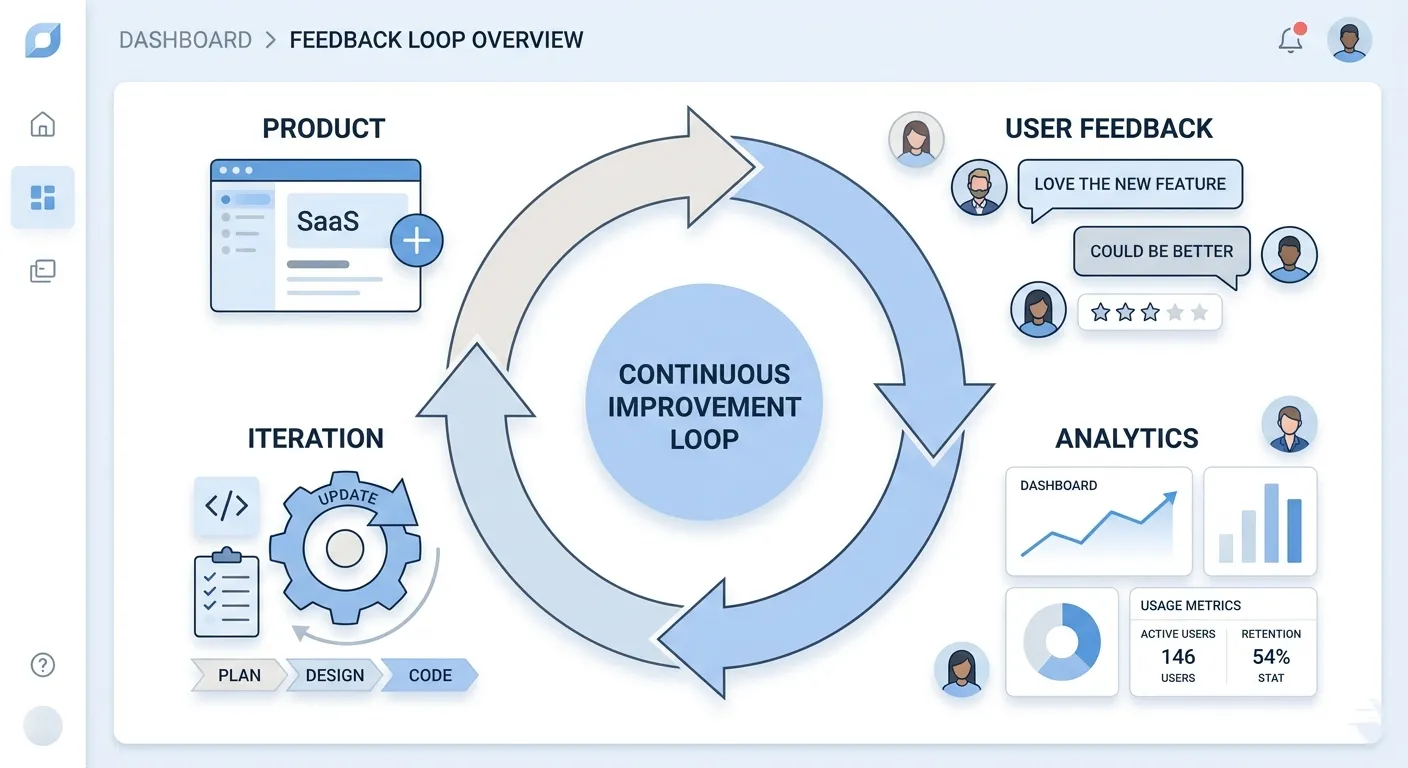
Collect feedback
Surveys
Interviews
Support tickets
Product analytics
Analyze patterns
Identify recurring issues
Prioritize high-impact problems
Implement improvements
Ship updates quickly
Communicate changes to users
Measure results
Retention
Engagement
Conversion rates
Tools and channels
In-app feedback widgets
Email surveys
Community forums
Example (Europe)
A fintech startup in Germany improved onboarding by simplifying KYC steps after user complaints. Result:
30% increase in completed sign-ups
Reduced support requests
Key takeaway: Listening to customers is not enough—you must act quickly.
Customer-Centric Product Development in Practice
Step-by-Step Process
Step 1: Start with a Minimum Viable Product (MVP) Build the simplest version that solves the core problem. Avoid:
Feature overload
Long development cycles
Step 2: Launch early Release to a small group of users:
Beta testers
Early adopters
Step 3: Measure real behavior Focus on:
Usage frequency
Drop-off points
Feature adoption
Step 4: Iterate fast Ship improvements weekly or bi-weekly.
Real-world comparison
Failure case:
A startup builds a complex AI tool without user validation → low adoption. Success case:
A competitor launches a simple tool, gathers feedback, and iterates → higher retention and growth.
Balancing Customer Needs with Business Goals
Customer-centric doesn’t mean “build everything customers ask for.”
What to prioritize
Problems that align with your product vision
Features that impact revenue or retention
Requests from high-value users
What to avoid
Feature creep
Conflicting feedback from different segments
Short-term fixes that harm long-term strategy
Decision framework
Use this scoring system:
Impact on users (1–5)
Revenue potential (1–5)
Implementation effort (1–5)
Prioritize high-impact, high-revenue, low-effort features.
Common Mistakes in Customer-Centric Growth

1. Confusing feedback with demand
Not all feedback reflects willingness to pay. Fix: Validate with real purchasing behavior.
2. Overbuilding too early
Adding features before validation leads to wasted time and resources. Fix: Start small and iterate.
3. Ignoring churn signals
Acquisition gets attention, but retention drives growth. Fix: Track why users leave and address root causes.
4. Serving too many audiences
Trying to please everyone results in weak positioning. Fix: Focus on a clear niche first.
5. Lack of clear metrics
Without data, decisions become guesswork. Fix: Track:
Customer acquisition cost (CAC)
Lifetime value (LTV)
Retention rates
Scaling Customer-Centric Growth
Once you achieve product-market fit, you can scale efficiently.
Growth levers
Referrals: Satisfied users bring new customers
Content marketing: Educate your audience
Product-led growth: Let the product drive acquisition
Example (US market)
Many SaaS companies use freemium models:
Free version attracts users
Paid upgrades access value
Example (UK/EU market)
Trust signals matter more:
Transparent pricing
GDPR compliance
Strong customer support
Key Takeaways and Next Steps
Customer-centric growth is not a tactic—it’s a mindset.
Recap
Start with real customer problems
Validate product-market fit before scaling
Build clear value propositions
Use continuous feedback loops
Focus on retention, not just acquisition
Actionable next step
Run this simple exercise today:
Identify your target customer
Interview 5–10 users
List their top 3 problems
Validate which problem they would pay to solve
This alone can dramatically improve your product direction.
Disclaimer
This content is for informational purposes only and does not constitute business or financial advice. Always validate strategies based on your specific market and circumstances.