Many great businesses start with a simple idea. But ideas alone don’t build companies—execution does. For first-time founders, the biggest challenge is moving from concept to something real that users can test and interact with.
This is where the idea to MVP process becomes critical. A Minimum Viable Product (MVP) is the simplest version of your product that still delivers value to users. Instead of building a full product upfront, founders create a lightweight version to test whether the idea actually solves a real problem.
In startup ecosystems across the United States, the UK, and Europe, MVP development has become the standard approach for launching new ventures. Companies like Airbnb, Dropbox, and Spotify all started with early MVP versions before evolving into global platforms.
This guide explains how to go from idea to MVP step by step, helping first-time founders validate ideas, reduce risk, and launch faster.
Why the MVP Approach Matters for Startups
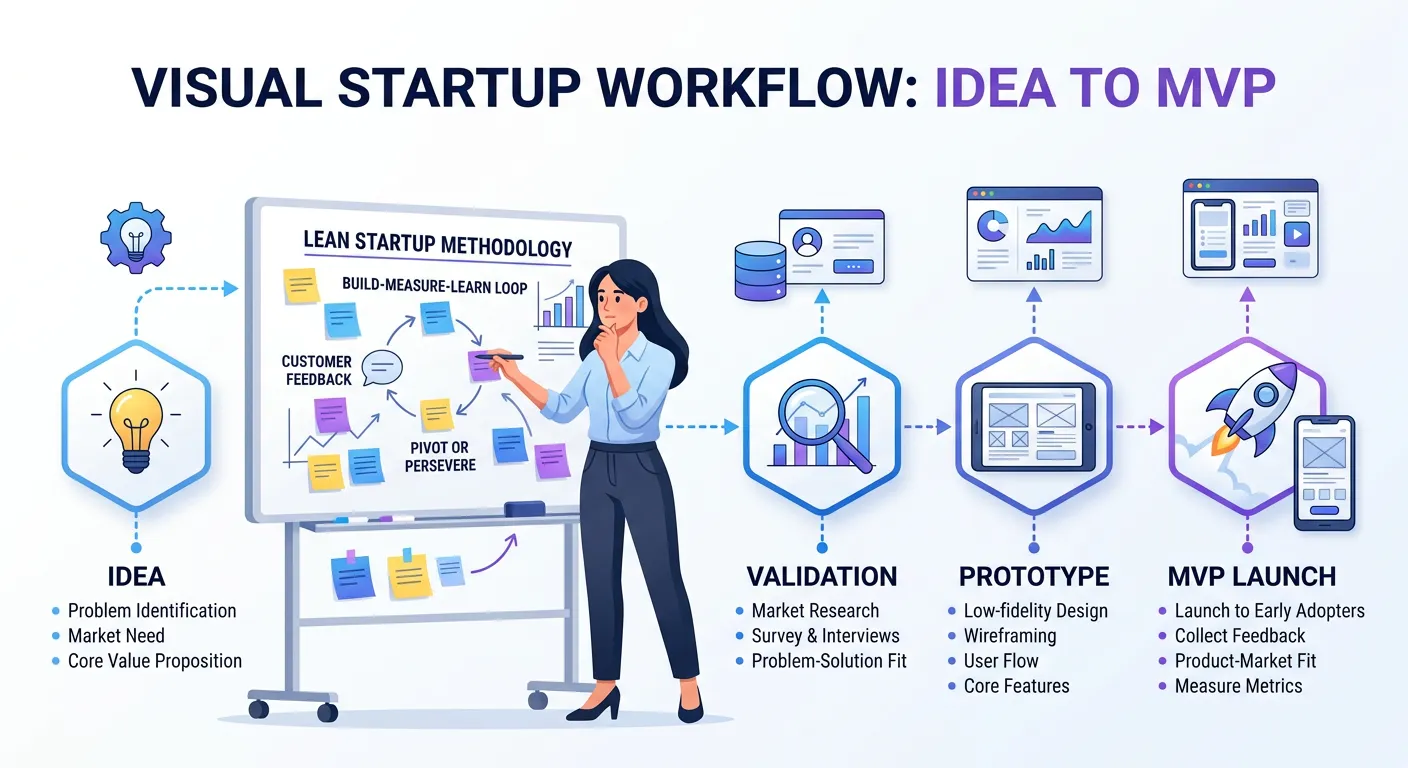
Many founders make the same early mistake: they try to build the perfect product before talking to users. This often leads to wasted time, money, and effort.
The minimum viable product for startups flips that approach.
Instead of spending months building features, you start with a simple version that tests whether your idea works in the real world.
Benefits of an MVP
Validates your idea quickly
Reduces development costs
Collects real user feedback
Attracts early investors or partners
Helps refine your product roadmap
In startup hubs like Silicon Valley, London, Berlin, and Amsterdam, investors often expect founders to show traction through an MVP before funding a full product build.
Step 1: Clarify the Problem You Are Solving
Before writing a single line of code, you need to clearly define the problem your product solves. Successful startups focus on real problems experienced by real people.
Ask these key questions:
Who experiences this problem?
How are they solving it today?
Why are current solutions insufficient?
How often does the problem occur?
How painful or costly is it?
For example:
A US logistics startup might reduce delivery inefficiencies for small retailers.
A European fintech startup may simplify cross-border payments for freelancers.
A UK health platform might help patients book specialist appointments faster.
If the problem is not meaningful, even a perfect product will fail.
Step 2: Validate the Idea Before Building
One of the most important steps in the idea to MVP journey is idea validation. You want evidence that people care about your solution before investing significant resources.
Practical Ways to Validate a Startup Idea

1. Customer Interviews Talk to 10–30 potential users and ask about their challenges. Focus on understanding their behavior rather than pitching your product. 2. Landing Page Tests
Create a simple webpage describing the solution and track:
Sign-ups
Email interest
Pre-orders
Tools commonly used by founders include:
Webflow
Carrd
WordPress
Notion sites
3. Prototype Testing Use tools like:
Figma
Adobe XD
InVision
These allow you to test user flows without writing code. 4. Community Feedback Post your concept in relevant communities:
Reddit startup forums
Product communities
LinkedIn founder groups
niche industry Slack groups
Early feedback helps identify flaws before development begins.
Step 3: Define the Core Value of Your MVP
An MVP is not a “small product.” It is a focused product that solves one clear problem extremely well. First-time founders often overload MVPs with unnecessary features.
The MVP Feature Filter
Ask three simple questions for every feature:
Does this feature solve the core problem?
Is it required for the product to function?
Will users notice if it’s missing?
If the answer to all three is no, remove it.
Example MVP Breakdown
Idea: Marketplace connecting freelance designers with startups. Core MVP Features:
User signup
Designer profiles
Job posting
Messaging
Features to delay:
AI matching
Advanced analytics
Mobile apps
Payment automation
Focus on essential functionality first.
Step 4: Choose the Right MVP Type

Not every MVP requires complex software development. Many successful startups start with extremely simple prototypes.
Common MVP Types
1. Landing Page MVP A simple page describing your solution and collecting sign-ups. Example: Early SaaS startups often test demand this way. 2. Concierge MVP
Manually deliver the service instead of automating it. Example:
In its early days, Airbnb founders manually photographed apartments and helped hosts list them. 3. No-Code MVP Use platforms like:
Bubble
Glide
Airtable
Zapier
These allow founders to build functional products without coding. 4. Prototype MVP A design-only product used for testing workflows. 5. Single Feature MVP
Launch with only one powerful feature that solves the core problem. Selecting the right MVP type can reduce startup costs dramatically.
Many early-stage MVPs cost $500–$5,000, while traditional software builds can exceed $50,000–$100,000 depending on complexity.
Step 5: Build the MVP Efficiently
Once validation and scope are clear, the next step is startup MVP development. Speed matters. The goal is learning, not perfection.
Typical MVP Development Timeline
Many successful startups aim to launch an MVP in 4–12 weeks.
Common MVP Tech Options
No-Code / Low-Code
Bubble
Webflow
Glide
Airtable
Best for testing ideas quickly. Freelance Development Platforms like Upwork or Toptal allow founders to hire developers for short projects. Typical costs:
Freelance developer: $30–$120 per hour
MVP build: $5,000–$30,000 depending on scope
Startup Tech Cofounder Many founders partner with a technical cofounder to build early versions. Startup communities in cities like San Francisco, London, and Berlin often encourage this model.
Step 6: Launch Early and Collect Real Feedback

Many founders delay launch because they feel the product isn’t ready. But the purpose of an MVP is learning from real users. Launch when the product is:
Stable enough to use
Solves the main problem
Delivers clear value
Where to Find Early Users
Personal network
Startup communities
LinkedIn groups
Industry forums
Product Hunt
Niche newsletters
Early users often provide the most valuable feedback because they care about the problem.
Step 7: Measure What Actually Matters
After launch, founders must track meaningful data.
Key MVP Metrics
Focus on metrics that indicate real product value. Examples include:
User activation rate
Weekly active users
Retention rate
Customer feedback
Conversion rate
Vanity metrics such as social media followers often provide little insight. A small group of highly engaged users is more valuable than thousands of inactive sign-ups.
Common Mistakes First-Time Founders Make
The journey from idea to MVP is full of learning opportunities, but certain mistakes appear repeatedly.
1. Building Too Many Features
Adding features delays launch and confuses users.
2. Ignoring Customer Feedback
Founders sometimes fall in love with their idea instead of listening to users.
3. Spending Too Much Too Early
Large development budgets increase risk before validation.
4. Waiting Too Long to Launch
A delayed launch prevents real-world learning.
5. Targeting Everyone
Successful MVPs focus on a narrow early audience.
Real-World MVP Examples
Looking at MVP examples for startups shows how simple early products can be.
Dropbox
Dropbox started with a simple demo video explaining the product concept before building the full system. The video alone generated thousands of early sign-ups.
Airbnb
The founders initially rented out air mattresses in their apartment to test the idea of peer-to-peer lodging.
Uber
Uber’s MVP was limited to black car rides in San Francisco with a basic mobile app. Each example demonstrates the same lesson: Start small. Prove demand. Then expand.
Tools That Help Founders Build MVPs Faster
Modern founders have access to tools that dramatically reduce development time.
MVP Development Tools
Design & Prototyping
Figma
Adobe XD
No-Code Platforms
Bubble
Webflow
Glide
User Feedback
Typeform
Google Forms
Hotjar
Analytics
Google Analytics
Mixpanel
Amplitude
These tools help founders focus on learning rather than infrastructure.
Final Thoughts: Turning Your Idea Into a Real Startup
The journey from idea to MVP is one of the most important phases of building a startup. It transforms a concept into something real that users can test, critique, and improve. For first-time founders, the key principles are simple:
Focus on solving a real problem
Validate the idea early
Build only essential features
Launch quickly
Learn from real users
Great companies rarely start as perfect products. They start as small experiments that evolve through feedback and iteration.
If you have a startup idea today, the best next step is not writing a business plan—it’s beginning the MVP validation process.
Start small. Launch fast. Learn quickly.