
Starting and growing a business is exciting—but ignoring the legal and financial basics for entrepreneurs can quietly destroy even the best ideas. Many startups fail not because of poor products, but because of compliance issues, tax mistakes, or cash flow mismanagement.
If you're a founder, owner, or early-stage entrepreneur, understanding these fundamentals is not optional. It’s what protects your business, keeps you compliant, and helps you scale sustainably.
This guide breaks down the core legal and financial pillars every entrepreneur should understand—without jargon, but with practical, real-world clarity.
1. Choosing the Right Business Structure
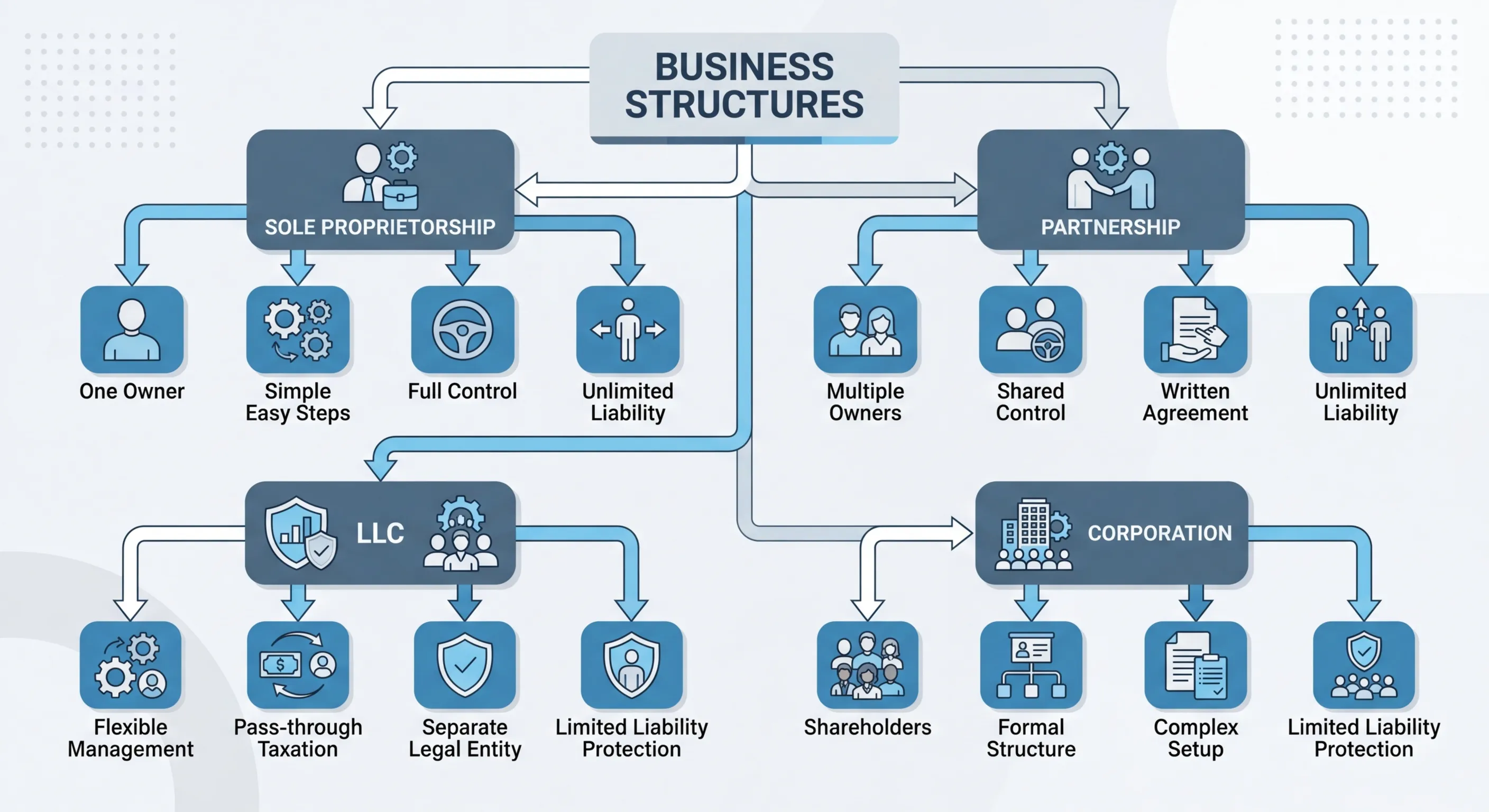
Your business structure affects taxes, liability, and how you operate. Choosing the wrong one can lead to unnecessary costs or risks.
Common Business Structures
Sole Proprietorship
Simplest setup
Full control
Unlimited personal liability
Partnership
Shared ownership
Flexible structure
Risk of disputes if not documented properly
Limited Liability Company (LLC) / Limited Company (Ltd)
Separate legal entity
Protects personal assets
Common in the US, UK, and EU
Corporation (C Corp / S Corp)
More complex
Ideal for scaling and raising capital
Higher compliance requirements
Practical Tip
In the US, many startups choose an LLC early on for flexibility.
In the UK/EU, a limited company (Ltd) is often preferred for liability protection.
Mistake to avoid: Starting as a sole proprietor without understanding personal liability exposure.
2. Registering Your Business and Staying Compliant

Once you choose a structure, registration is mandatory.
Key Requirements
Business name registration
Tax identification number (e.g., EIN in the US)
Local licenses or permits
Industry-specific regulations
Regional Differences
United States: Registration varies by state; federal EIN required.
UK/EU: Companies must register with national authorities (e.g., Companies House in the UK).
Canada/Australia: Similar registration plus GST/VAT considerations.
Compliance Checklist
Renew licenses annually
File required reports
Maintain accurate records
Mistake to avoid: Ignoring local compliance rules—penalties can range from hundreds to thousands (e.g., $500–$5,000+ or €400–€4,500).
3. Understanding Contracts and Legal Agreements
Contracts protect your business relationships. Without them, you're relying on trust—which is risky.
Essential Contracts for Entrepreneurs
Founder agreements (equity, roles, exit terms)
Client contracts (scope, payment terms)
Supplier agreements
Employment or contractor agreements
Non-disclosure agreements (NDAs)
Key Elements of a Strong Contract
Clear scope of work
Payment terms and deadlines
Dispute resolution clause
Termination conditions
Real-World Example
A startup in the US hires a freelance developer without a contract. The developer delays delivery, and there's no legal ground to enforce deadlines. Result: lost time and revenue.
Mistake to avoid: Using vague or copied templates without customization.
4. Business Taxes: What You Must Know

Taxes are one of the most critical parts of the legal and financial basics for entrepreneurs.
Types of Business Taxes
Income tax
Sales tax / VAT
Payroll tax (if hiring employees)
Corporate tax (depending on structure)
Regional Overview
US: Federal + state taxes; sales tax varies by state
UK/EU: VAT typically ranges from 15%–25%
Canada: GST/HST applies
Australia: GST at 10%
Key Practices
Track all income and expenses
Set aside 20–30% of revenue for taxes (general rule)
File on time to avoid penalties
Example
A freelancer earning $80,000 may owe $16,000–$24,000 in taxes.
A UK business earning £60,000 must account for VAT and corporation tax.
Mistake to avoid: Spending revenue without accounting for tax obligations.
5. Financial Management and Cash Flow Basics
Profit doesn’t equal cash. Many businesses fail because they run out of cash—not because they aren’t profitable.
Key Financial Concepts
Revenue vs Profit
Revenue = total income
Profit = revenue minus expenses
Cash Flow
Money moving in and out of your business
Critical for survival
Simple Cash Flow Framework
Track incoming payments
Monitor outgoing expenses
Forecast future cash needs
Maintain a cash buffer (3–6 months of expenses)
Example
Monthly revenue: $10,000
Expenses: $8,000
Profit: $2,000
But if clients pay late, you may still face a cash shortage. Mistake to avoid: Ignoring cash flow projections.
6. Setting Up Basic Accounting Systems
You don’t need to be an accountant—but you must understand the basics.
What You Need
Business bank account
Accounting software (e.g., cloud-based tools)
Expense tracking system
Key Financial Documents
Profit & Loss Statement (P&L)
Balance Sheet
Cash Flow Statement
DIY vs Professional Help
Early stage: basic tools + self-management
Growth stage: hire an accountant or bookkeeper
Cost Expectations
Software: $10–$50/month
Accountant: $500–$3,000/year or more depending on complexity
Mistake to avoid: Mixing personal and business finances.
7. Protecting Your Business: Insurance and Risk Management
Legal compliance isn’t enough—you also need protection against risk.
Types of Business Insurance
General liability insurance
Professional liability (errors & omissions)
Property insurance
Cyber insurance (increasingly important)
Why It Matters
Lawsuits can cost thousands to millions
Insurance acts as a financial safety net
Example
A consultant in Europe faces a client lawsuit for project failure. Legal fees alone can exceed €10,000 without insurance.
Mistake to avoid: Assuming “it won’t happen to me.”
8. Funding, Investment, and Financial Planning

Understanding how money flows into your business is essential for growth.
Common Funding Options
Bootstrapping (self-funded)
Loans
Angel investors
Venture capital
Key Considerations
Ownership dilution
Repayment terms
Growth expectations
Financial Planning Basics
Set clear revenue goals
Forecast expenses
Plan for scaling costs
Example
Raising $100,000 might require giving up 10–20% equity
A loan of €50,000 may require fixed monthly repayments regardless of revenue
Mistake to avoid: Taking funding without understanding long-term implications.
Conclusion: Build on a Strong Foundation
Mastering the legal and financial basics for entrepreneurs isn’t just about avoiding problems—it’s about building a business that lasts.
Key Takeaways
Choose the right business structure early
Stay compliant with local regulations
Use contracts to protect your interests
Understand and plan for taxes
Manage cash flow proactively
Set up simple but effective accounting systems
Protect your business with insurance
Be strategic about funding
Actionable Next Step
Start with a simple audit:
Do you have proper registration?
Are your finances tracked monthly?
Do you use contracts for all agreements?
Fixing these fundamentals today can prevent major issues tomorrow.