
The Resume That Gets You the Interview Is Not the Same Resume That Gets You the Job
A hiring manager at a mid-size London fintech recently told a recruiter something worth writing down: "I reject 70% of applications before I read a single word." She was talking about formatting. Specifically, she was talking about resumes that arrive as dense walls of text, with no clear hierarchy, no numbers, and job titles buried under paragraphs of duties.
She is not an outlier. According to a 2025 Jobscan study, 75% of resumes submitted to large employers are rejected by an Applicant Tracking System (ATS) before a human ever opens them. The candidates who make it through are not always the most qualified. They are the ones who understand how the filter works.
Here is the uncomfortable truth: most people write a resume to describe what they have done. Recruiters read a resume to decide what you can do next. Those are not the same document.
This guide shows you how to write the version that gets read — by the machine and the human behind it.
What a Recruiter Actually Does With Your Resume (in 7 Seconds)
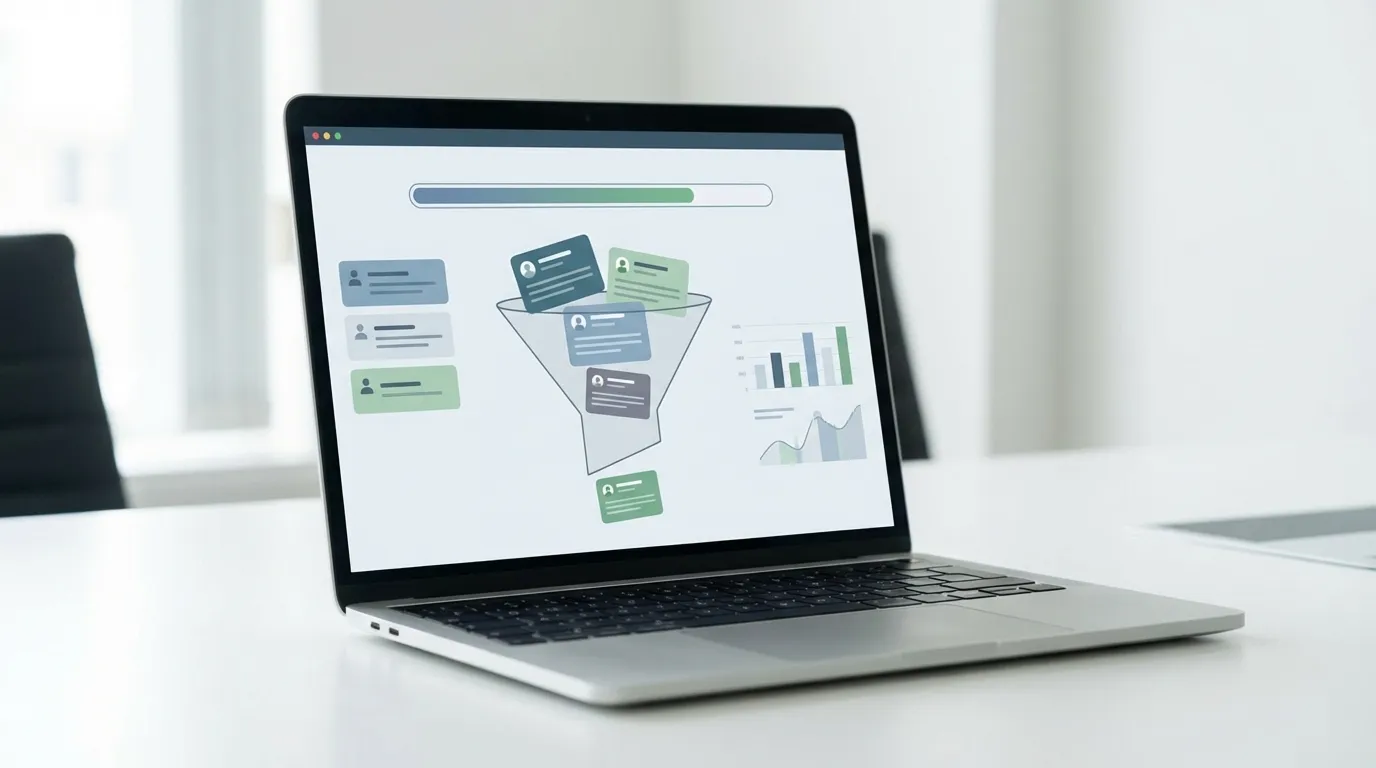
Before you rewrite a single line, understand the process on the other end.
Most corporate hiring runs through an ATS — software that parses your resume for keywords, formatting compatibility, and role-relevant signals. The most common systems in 2026 are Workday, Greenhouse, Lever, and iCIMS. Each has quirks, but they share one critical vulnerability: they cannot read what they cannot parse.
Tables, text boxes, headers and footers, graphics, and two-column layouts are ATS killers. The system reads them as garbled text or skips them entirely. Your beautifully designed Canva resume looks impressive as a PDF. To an ATS, it is noise.
If the resume survives the ATS, a recruiter typically spends 6–10 seconds on it before deciding whether to read further. Eye-tracking studies from the Nielsen Norman Group show that recruiters scan in an F-pattern: top-left to top-right, then down the left margin. Your name, current title, and first bullet point are load-bearing. Everything else is secondary.
That changes how you should write every section.
Step-by-Step: How to Rebuild Your Resume This Week
Step 1: Choose the right format
Use a single-column, reverse-chronological format for 90% of applications. Skills-based or functional CVs are widely mistrusted by UK and US recruiters alike — they signal you are hiding something, usually a gap or a lack of relevant experience.
Exception: if you are making a significant industry pivot, a hybrid format (brief skills summary at the top, then chronological history) is acceptable. Label it clearly.
File format: Always submit as a PDF unless the job posting specifically requests a Word document (.docx). PDFs preserve formatting across systems. Name the file: FirstName-LastName-JobTitle-2026.pdf — not Resume_Final_v3.pdf.
Step 2: Rewrite your summary section
Your summary is not a job objective. Nobody cares what you are looking for. They care what you offer.
Write three sentences maximum:
Sentence 1: What you do, how long you have done it, and in what context (sector, company size, geography).
Sentence 2: One specific, quantified achievement from the last three years.
Sentence 3: What you are moving toward and why it fits this role.
Example (bad): "Experienced marketing professional looking for a challenging role in a dynamic environment."
Example (good): "B2B content strategist with 7 years in SaaS and fintech, including experience scaling organic traffic from 12,000 to 140,000 monthly visits at a Series B startup. Specialising in long-form SEO content and editorial team management; now targeting content director roles at remote-first companies in the $50M–$500M revenue range."
That second version passes an ATS keyword scan, tells a story, and gives the recruiter a reason to keep reading. It takes 15 minutes to write. Most people skip it entirely.
Step 3: Quantify everything that can be quantified
Recruiters cannot evaluate adjectives. "Managed a large team" tells them nothing. "Managed a team of 11 across UK and India, reducing project delivery time by 22% over two years" gives them something to anchor a conversation around.
For every role in your last 10 years, identify:
A number that shows scale (team size, budget, revenue, volume)
A number that shows impact (percentage change, cost saved, time reduced)
A number that shows growth (promotion speed, accounts grown, audience built)
If you genuinely cannot quantify something, use a qualifier: "one of three people globally responsible for..." or "first hire in this function, building the team from scratch." Specificity beats vagueness even when exact numbers are not available.
Step 4: Match keywords to the job posting — precisely
Print out the job description. Highlight every skill, tool, and qualification mentioned more than once. Those are the ATS keywords. Now check your resume. If a skill appears in the job posting but not in your resume — and you actually have that skill — add it. In your own words, but add it.
Do not stuff keywords. Do not list tools you cannot use. ATS filters for presence; interviewers test for depth.
Step 5: Build your portfolio (even if you think you do not need one)
Here is the part most guides skip: a portfolio is no longer optional for most professional roles, including non-creative ones.
Product managers are expected to show case studies. Finance professionals are expected to link to published reports or models. Operations people are expected to show process documentation. If your work is confidential, anonymise it. If your outputs are intangible, document your thinking.
A portfolio does not need to be a website. It can be a Google Drive folder, a Notion page, or a PDF. What it must contain:
3–5 examples of your best work, with context (the problem, your approach, the outcome)
At least one example that shows collaboration, not just individual output
Contact information and a link to your LinkedIn
The portfolio goes in your resume header: Portfolio: notion.so/yourname or Work samples: drive.google.com/yourname
US vs UK: The Terminology and Format Differences That Matter

This is where candidates lose opportunities through avoidable errors.
Document name:
US: Resume (1–2 pages maximum for most roles; 2 pages is standard for 10+ years of experience)
UK: CV (2 pages is standard; 3 pages acceptable at senior or academic level)
Personal information:
US: Do not include a photo, date of birth, or nationality. These are legally sensitive and many ATS systems flag resumes that contain them.
UK: Photo is not expected but not prohibited. Date of birth is optional. Nationality may be relevant for visa sponsorship disclosure — include only if directly relevant.
Salary:
If asked to include salary expectations, US candidates should state a range in USD: $95,000–$115,000 base. UK candidates should use GBP: £62,000–£72,000 ($78,000–$90,000). Never state a single figure — a range gives you negotiation room.
Referees:
US: References available upon request (or omit entirely — it is assumed).
UK: References available upon request is standard. Two referees are typically required at offer stage — have them lined up in advance.
Employment dates:
Both markets: Use month and year (March 2022 – November 2024), not just year. Gaps measured in years are far harder to explain than gaps measured in months.
What Most Candidates Get Wrong
They optimise for design over parseability. A resume that looks stunning as a PDF and fails the ATS is a resume that goes nowhere. Use clean formatting, standard fonts (Arial, Calibri, Times New Roman), and zero tables or text boxes in the main body.
They write for the role they have, not the role they want. Your resume should be forward-oriented. Lead with the skills and experiences most relevant to the next role, even if they are not your most recent.
They ignore the cover letter. In 2026, fewer than 40% of applicants submit a cover letter. When a role asks for one and you skip it, you have already lost ground. When a role doesn't ask for one and you include a sharp, specific, three-paragraph letter — you stand out. The letter should reference something specific about the company. One sentence of genuine research is worth more than three paragraphs of general enthusiasm.
They send the same resume everywhere. Every application should have a tailored summary and at least three role-specific keyword adjustments. This takes 20 minutes per application. It increases callback rates by 40–60% according to Jobscan's 2025 application data. That is not optional effort — it is the job.
Real-World Example: One CV Rewrite, One Outcome

Priya, a senior UX researcher with nine years of experience, had been applying to product roles at global tech companies for four months. She had received two callbacks from roughly 60 applications.
Her original CV listed responsibilities. "Conducted user research. Synthesised findings. Presented to stakeholders." Her portfolio was a password-protected Figma file she sent by request.
Over one weekend, she made three changes:
Rewrote every bullet to include an outcome: "Led discovery research for a mobile onboarding redesign that reduced drop-off by 31% in the first quarter post-launch."
Added a public Notion portfolio with five case studies, each structured as: problem → method → finding → impact.
Updated her LinkedIn headline to: UX Researcher | B2C Mobile & E-commerce | Open to Senior & Lead Roles
In the following six weeks, she received 11 callbacks and two offers. One was a remote-first role at a US company paying $118,000 ($93,000 / £74,000 in UK-equivalent purchasing power) — a 28% uplift on her previous salary.
She changed the document. The document changed the outcome.
The Data Point Worth Knowing
LinkedIn's 2025 Hiring Trends report found that profiles with a portfolio link or featured work samples receive 36% more recruiter messages than equivalent profiles without one. Among applicants for senior roles ($100,000+ / £75,000+), the presence of quantified achievements in the first three bullet points of each role was the single strongest predictor of interview conversion — stronger than years of experience, company brand, or education level.
That number is not a nice-to-have. It is the brief.
Three Takeaways and One Specific Action
Key takeaways
ATS compliance comes before design. A single-column, keyword-matched, PDF resume in a standard font will outperform a visually impressive document that the system cannot parse.
Quantify every achievement that can be quantified. Numbers give recruiters something to hold onto and something to talk about in the interview — which is the entire point of the document.
A portfolio is expected, not exceptional. Three to five case studies, publicly accessible, with clear problem-outcome framing, will differentiate you in most professional fields.
Your action for this week: Take your current resume and rewrite the first bullet point of your most recent role. Make it follow this formula: [Action verb] + [what you did] + [measurable outcome] + [context or scale]. Then do that for every role. That rewrite alone will double your ATS score on most platforms.
This article reflects general trends and market data as of April 2026. Always verify current salary benchmarks and employment law requirements in your region before making career decisions.