
The Version Nobody Posts on Instagram
In March 2025, a UX designer from Edinburgh spent her third consecutive month working from a co-working space in Lisbon. The photos she posted showed sunlit cafés, weekend trips to the Algarve, and a laptop framed against the Tagus river at golden hour.
What the photos did not show: the morning she missed a client deadline because her apartment's Wi-Fi went down and the nearest café did not open until 10am — two hours after her 8am GMT standup. The week she spent 14 hours navigating Portuguese tax registration because her accountant in Edinburgh had never dealt with a client who was tax-resident abroad. The conversation with her long-term partner, still in Scotland, about whether this arrangement had a future beyond six months.
She is not unusual. The digital nomad lifestyle is real, genuinely viable, and in many ways as good as it looks. It is also more complex, more logistically demanding, and more financially nuanced than the content that promotes it typically acknowledges.
This guide covers both versions.
What Digital Nomad Life Actually Looks Like in 2026

The term "digital nomad" covers a wide spectrum. Understanding where you sit on that spectrum is the first step to building something sustainable.
The slow traveller: Based in one location for one to six months at a time. Rents an apartment, joins a local co-working space, builds a temporary routine. Low logistical overhead, strong work productivity, genuine immersion in local culture. This is the model most compatible with full-time remote employment and long-term stability.
The location-independent freelancer: Moves every two to eight weeks. Higher logistical overhead, requires strong client communication systems and reliable backup internet everywhere. Compatible with freelancing but requires disciplined client management to avoid the lifestyle consuming the work.
The perpetual traveller: Always moving, rarely staying more than two weeks. Extremely high logistical overhead. Compatible with asynchronous, project-based work where deliverables matter and presence does not. Difficult to sustain with any client or employer who requires consistent availability.
Most sustainable digital nomad careers sit in the first category. The Instagram version of perpetual travel is real — but it is rarely the model that sustains a serious professional career beyond 12 to 18 months without significant friction.
According to MBO Partners' 2025 State of Independence report, there are approximately 18.1 million self-identified digital nomads in the US alone — up from 10.9 million in 2020. Of those, 63% describe their primary motivation as lifestyle flexibility rather than travel per se. The destination is often secondary to the freedom to choose it.
Step 1: Establish Whether Your Work Is Actually Nomad-Compatible

Before you book anything, audit your work honestly against three criteria.
Criterion 1: Is your output deliverable-based or presence-based?
Deliverable-based work — writing, design, engineering, consulting, data analysis, financial modelling — can be done anywhere with a reliable internet connection and a quiet space. Presence-based work — managing a team that needs real-time oversight, client-facing roles with in-person expectations, roles where visibility at headquarters affects career progression — cannot.
If your current role is presence-based, the path to digital nomad life runs through finding a different role, not negotiating with your current employer. Most managers who agree to remote work arrangements do not anticipate their employee moving to Southeast Asia. That conversation, had after the arrangement is agreed, rarely ends well.
Criterion 2: What are your internet requirements?
Video calls require a minimum of 10Mbps upload speed — reliably, not occasionally. If your work involves frequent video calls, large file transfers, or cloud-based tools that require consistent connectivity, you need to be honest about which destinations can support that. A beach in rural Thailand might not. Lisbon, Medellín, Chiang Mai, and Tallinn reliably can.
Research connectivity before you commit to any location. Nomad List (nomadlist.com) provides crowd-sourced data on internet speeds, cost of living, weather, and safety for hundreds of cities globally. It is the most practical single resource for location research.
Criterion 3: What time zone constraints does your work carry?
If your employer or clients require you to be available during specific hours — US Eastern business hours, UK business hours, European business hours — your geographic options are constrained by those windows. A UK freelancer with US clients requiring EST overlap can work from Western Europe comfortably. Working from Southeast Asia means starting calls at 10pm or later. That is survivable for a month. It is unsustainable for a year.
Map your required overlap hours to a world map before you choose destinations. Your lifestyle is a function of your time zone constraints as much as your visa options.
Step 2: Sort Your Legal and Tax Situation Before You Leave

This is the section most digital nomad content skips entirely because it is unglamorous. It is also the section that determines whether your nomadic career is sustainable or whether it ends with a tax investigation, a visa overstay, or a client contract terminated for non-compliance.
Tax residency
Tax residency is determined differently in every country, but the general principle is consistent: if you spend more than a certain number of days per year in a country — typically 90 to 183 days — that country may claim the right to tax your globally income.
UK citizens working abroad: The UK's Statutory Residence Test (SRT) determines whether you remain UK tax-resident. If you spend more than 183 days in the UK in a tax year, you are UK tax-resident regardless of where you work. If you spend fewer than 16 days in the UK (having been resident in previous years), you are non-resident. The rules between these thresholds are complex and depend on "ties" — UK home, UK employer, UK family. Consult a specialist international tax adviser before you leave, not after.
US citizens working abroad: The US taxes its citizens on globally income regardless of where they live — one of only two countries in the world that does this (the other is Eritrea). The Foreign Earned Income Exclusion (FEIE) allows US citizens abroad to exclude up to $126,500 (2026 figure) of foreign-earned income from US federal tax — but you must qualify by meeting either the Physical Presence Test (330 days outside the US in a 12-month period) or the Bona Fide Residence Test (established residency in a foreign country). This does not eliminate US tax obligations — it reduces them. You still file a US return every year, regardless of where you live.
Digital nomad visas: As of April 2026, more than 60 countries offer formal digital nomad visa programmes — including Portugal, Spain, Germany, Greece, Costa Rica, Indonesia (Bali), Thailand, and the UAE. These visas typically allow stays of 12 months (often renewable), provide legal work authorisation for remote work for foreign employers, and in some cases offer preferential tax treatment. Key ones for English-speaking nomads in 2026:
Portugal's D8 visa: 12 months, renewable, income requirement of approximately €3,040 ($3,290) per month. No NHR tax regime as of 2024, but standard Portuguese income tax applies with a flat rate for non-habitual residents.
Spain's Digital Nomad Visa: 12 months, renewable up to 5 years, income requirement of 200% of Spanish minimum wage (approximately €2,646/$2,864 per month). Preferential tax rate of 24% on income up to €600,000 for the first four years.
Indonesia's Second Home Visa: Up to 10 years, no income requirement, but requires a financial deposit of approximately $130,000 in an Indonesian bank account. Not practical for most early-stage nomads.
UAE: No income tax. No personal tax on foreign income. 180-day freelance permit available for approximately $1,500. Popular among high-earning freelancers and contractors.
Do not overstay tourist visas. The Schengen Area allows 90 days in any 180-day period for non-EU citizens — a common trap for nomads who move between France, Spain, Italy, and Portugal without tracking their Schengen days carefully. Overstaying triggers fines, bans, and potential employment contract issues if your employer discovers you were working from an unauthorised location.
Employment contracts and location clauses
Many full-time remote employment contracts contain clauses specifying the country — or even the city — from which the employee is authorised to work. Working from Portugal while contracted to work in the UK may breach your employment contract, create payroll tax obligations for your employer in Portugal, and invalidate your employer's liability insurance.
Before you go anywhere for more than 30 days, read your employment contract carefully. If it contains a location clause, have an honest conversation with your employer or HR team. Some employers will accommodate international remote work with an amended agreement or an Employer of Record (EOR) arrangement. Others will not. Know which category your employer falls into before you buy the flight.
Step 3: Build the Financial Infrastructure for Nomadic Life
The finances of digital nomad life are more complex than a standard remote job — and the complexity is almost entirely administrative rather than prohibitive.
Banking and currency
UK nomads: Open a Wise (formerly TransferWise) or Revolut account before you leave. Both provide multi-currency accounts, low foreign exchange fees, and physical debit cards accepted globally. Do not rely on a standard UK high street bank account for daily spending abroad — the foreign transaction fees accumulate significantly over months.
US nomads: Charles Schwab's High Yield Investor Checking account reimburses all ATM fees globally and carries no foreign transaction fees. It is the standard recommendation among long-term US nomads for a reason. Pair it with a Wise account for currency management.
Income currency: If you earn in GBP or USD and spend in euros, Thai baht, or Colombian pesos, your effective cost of living fluctuates with exchange rates. Build a buffer of three months' expenses in your home currency as insurance against adverse currency movements.
Cost of living benchmarks
The financial case for digital nomad life is strongest when your income is denominated in a strong currency (USD, GBP, EUR) and your expenses are in a weaker one. As a benchmark for popular nomad destinations in 2026:
City | Monthly cost (comfortable, inc. accommodation) | Internet reliability |
|---|---|---|
Chiang Mai, Thailand | $1,200–$1,800 / £950–£1,420 | Excellent |
Medellín, Colombia | $1,400–$2,000 / £1,100–£1,580 | Very good |
Lisbon, Portugal | $2,800–$3,800 / £2,200–£3,000 | Excellent |
Tallinn, Estonia | $2,200–$3,000 / £1,740–£2,370 | Excellent |
Bali, Indonesia | $1,500–$2,500 / £1,185–£1,975 | Good (varies by area) |
Mexico City, Mexico | $1,800–$2,800 / £1,420–£2,210 | Very good |
Dubai, UAE | $3,500–$5,000 / £2,765–£3,950 | Excellent |
A UK professional earning £60,000 ($75,000) and spending three months per year in Chiang Mai, three in Medellín, and six in Lisbon will typically spend 25–35% less on living costs than they would in London — while maintaining a comparable quality of life on most metrics.
Emergency fund
Nomadic life amplifies the cost of unexpected events. A dental emergency in a country without travel insurance coverage. A laptop failure in a city with no Apple Store. A political situation that requires an unplanned flight home. A landlord who disappears with your deposit.
Maintain a minimum emergency fund of $5,000 / £4,000 in a liquid, accessible account — separate from your operational finances — at all times. This is not optional. It is the financial cushion that prevents a bad week from becoming a catastrophic month.
Step 4: Set Up Your Work Infrastructure for Anywhere

The practical reality of working nomadically is that your productivity depends almost entirely on decisions you make before you arrive somewhere — not after.
Internet redundancy
Never rely on a single internet source. The infrastructure for reliable nomadic work is:
Primary: Accommodation with documented fast Wi-Fi (verify the speed before booking — ask for a screenshot of a speed test from the host, not their stated speed)
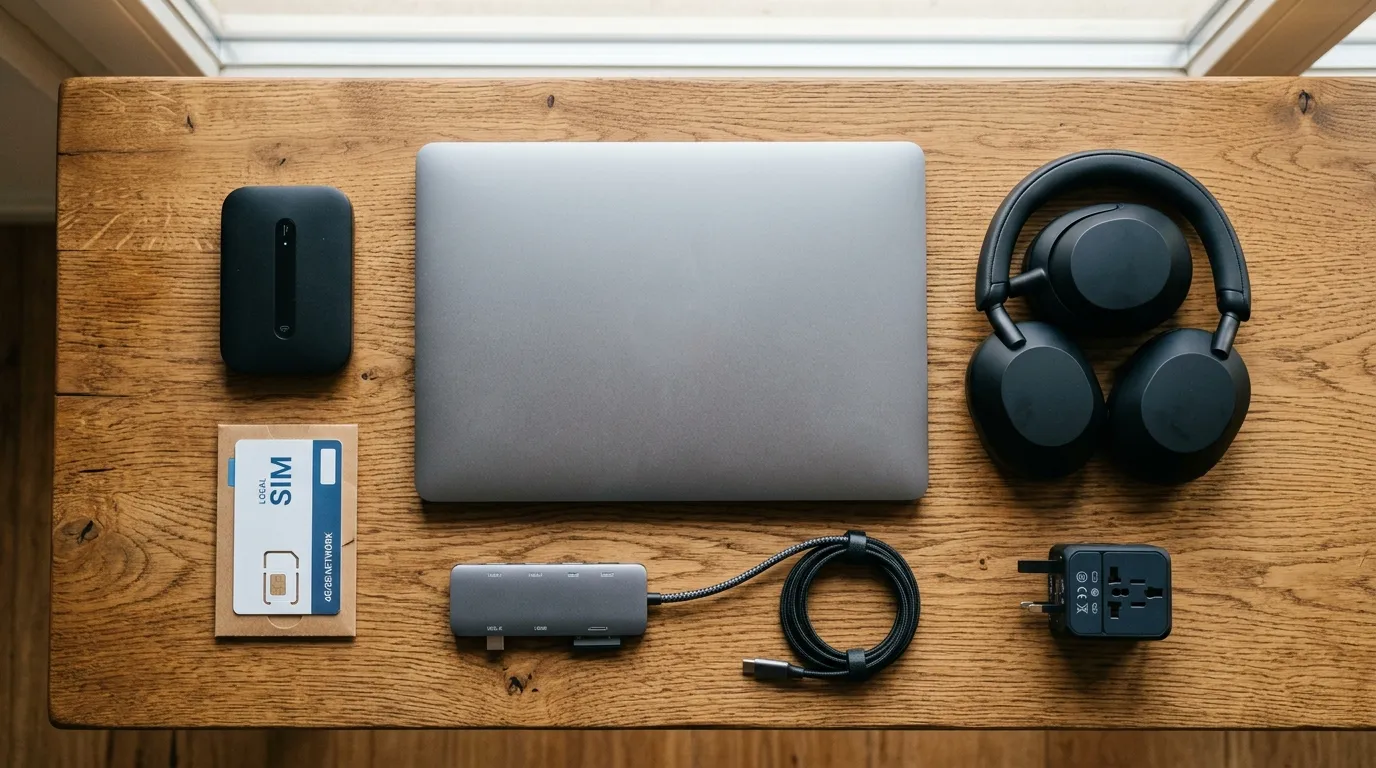
Secondary: A local SIM card with a data plan sufficient for a full working day of video calls. In most countries, a local SIM with 30GB of 4G data costs $5–$20/month. This is non-negotiable.
Tertiary: The nearest co-working space, researched and tested in the first 48 hours of arrival. Know where it is, what it costs, and that it has the connectivity you need before you need it urgently.
The morning the apartment Wi-Fi fails is not the morning to research co-working options.
Hardware
Travel with the minimum hardware required to do your job at full capacity — no more, no less. For most knowledge workers in 2026, this means:
Laptop (with a recent backup completed before departure)
Portable laptop stand and travel keyboard — non-negotiable for ergonomics over months, not weeks
Noise-cancelling headphones — the single most important piece of equipment for video calls in environments you do not control
Universal travel adapter
Portable battery pack for working from locations without convenient power
USB-C hub if your laptop has limited ports
Pack a spare laptop charger. Losing your only charger in a country where your laptop model is not sold is an entirely preventable crisis.
Communication systems
If you are working with a team or clients, they need to be able to reach you reliably during your stated working hours — regardless of where you are. This means:
A consistent, documented set of working hours communicated to your team or clients in advance of each location change
Slack or Teams status updates that reflect your current time zone and availability window
A shared calendar that reflects your actual working hours in local time
A proactive communication norm: if your connectivity is unreliable on a given day, tell people before the day starts, not after you miss something
The nomads who struggle professionally are almost always those who underinvest in communication infrastructure — who assume that being "remote" means being available when convenient. The nomads who thrive professionally are those who are more communicative, more documented, and more reliable than their office-based colleagues.
US vs UK: How the Nomad Experience Differs

Tax complexity:
US citizens face the highest administrative tax burden of any nationality pursuing nomadic work, due to citizenship-based taxation. Filing a US return every year, tracking FEIE eligibility, managing FBAR (Foreign Bank Account Report) obligations for foreign bank accounts above $10,000, and potentially filing state returns depending on your last state of residence — this is the reality for US nomads. Budget $500–$1,500 per year for a specialist expat CPA. It is worth every dollar.
UK citizens have a more manageable situation. Once you establish non-UK tax residency under the SRT, UK income tax obligations on foreign-earned income largely cease — though you remain liable for UK tax on UK-source income (rental income, UK dividends, etc.). Returning to the UK for more than 90 days in a tax year can trigger re-residency depending on your ties. Track your days carefully.
Employment rights:
UK employees working abroad retain most UK employment law protections — unfair dismissal rights, statutory redundancy, notice period entitlements — as long as the employment relationship remains UK-based. The nuance is that your employer may have obligations in your host country depending on duration and local labour law. Stays of more than 183 days in most countries trigger local employment law considerations.
US employees have fewer portable protections — at-will employment means most US employment rights are contractual rather than statutory, and they do not follow you abroad in the same way UK statutory rights do.
Health insurance:
This is the practical divide that matters most day-to-day.
UK nomads: NHS coverage applies in the UK but not abroad for non-emergency care. Purchase international health insurance before departure — providers including Cigna Global, AXA International, and SafetyWing offer policies from approximately £80–£200 ($100–$250) per month depending on coverage and age. SafetyWing's Nomad Insurance is the entry-level option at approximately $56/month; it is not comprehensive but covers emergency hospitalisation and evacuation.
US nomads: Standard US health insurance typically does not cover care abroad beyond emergency stabilisation. Purchase a dedicated international health insurance policy. Budget $150–$400/month for comprehensive coverage. This is not optional — a serious illness or accident in a country without a public health system, without adequate coverage, is financially catastrophic.
What Most Aspiring Nomads Get Wrong
They underestimate the administrative overhead. Tax registration, visa applications, health insurance, banking setup, lease agreements in foreign languages, SIM cards, co-working memberships — the logistics of nomadic life are real and time-consuming. The professionals who thrive are those who treat logistics as a professional discipline, not an afterthought.
They move too fast, too soon. The Instagram version of nomad life involves a new country every two to three weeks. The professional version involves staying long enough in each place to establish a routine, build local knowledge, and maintain the work productivity that funds the lifestyle. Two to four weeks is rarely enough. Two to four months is usually the minimum for genuine stability and productivity.
They neglect their professional network at home. Out of sight is out of mind in professional networks. Nomads who disappear from their industry community — who stop attending events, stop posting on LinkedIn, stop maintaining relationships — find that opportunities dry up faster than their savings. Stay visible. Post content. Maintain relationships. The network that generates your next opportunity does not know you are in Bali unless you tell it something worth reading.
They romanticise the lifestyle and ignore the loneliness. A 2025 survey by Nomad List found that 52% of digital nomads reported loneliness as a significant challenge — ahead of visa complexity, internet reliability, and tax obligations. Building genuine human connection in a new place every few months requires deliberate effort: co-working spaces, local language classes, expat communities, consistent video calls with people who matter. The professionals who sustain nomadic life long-term invest in human connection as deliberately as they invest in internet redundancy.
They fail to plan the exit. Digital nomad life is a phase for most people, not a permanent state. The professionals who navigate it best have a loose sense of what comes next — whether that is settling in a specific city, returning home, or transitioning to a different model of remote work. Having no exit plan does not make you more free. It makes you more reactive.
Real-World Example: The Nomad Career That Lasted
James, a senior product manager from Manchester, spent three years as a digital nomad between 2022 and 2025. His income throughout was £78,000 ($97,500) per year from a fully remote role at a US-based SaaS company.
His setup:
Registered as non-UK tax-resident in year one under the SRT (spending fewer than 90 days in the UK per tax year)
Obtained Portugal's D8 visa in year one, providing legal work authorisation and a base for Schengen travel
Maintained a Wise multi-currency account and a Revolut card for daily spending
Rented furnished apartments for two to four months at a time in Lisbon, Medellín, Tallinn, and Chiang Mai
Maintained strict working hours of 8am–5pm GMT across all locations, communicated explicitly to his team
Posted on LinkedIn once per week throughout — sharing professional observations from his work, not lifestyle content
Returned to the UK for 80 days per year to maintain relationships, attend industry events, and stay within the SRT non-resident threshold
His total cost of living across three years averaged £2,400 ($3,000) per month — roughly 40% less than his equivalent lifestyle cost would have been in Manchester. He saved approximately £180,000 ($225,000) over three years — the deposit for a property purchase he completed in Edinburgh in late 2025, when he was ready to slow down.
He returned to the UK with more savings, more professional experience, more international network, and a stronger LinkedIn following than when he left. The nomadic career did not interrupt his professional trajectory. It funded the next stage of it.
The Data Point Worth Knowing
MBO Partners' 2025 State of Independence report found that digital nomads with a structured approach to location selection, tax compliance, and professional visibility reported 41% higher career satisfaction and 28% higher income growth over a three-year period compared to nomads without structured systems. The lifestyle does not determine the outcome — the infrastructure does.
Three Takeaways and One Specific Action
Key takeaways
Digital nomad life is viable, sustainable, and professionally compatible — but only with the right legal, financial, and work infrastructure in place before you go. The logistics are manageable. Ignoring them is not.
The slow-travel model — staying two to four months per location — is significantly more compatible with serious professional work than the constant-movement model. Routine produces productivity. Novelty produces Instagram content.
Tax and visa compliance is not optional administration. It is the structural foundation of a nomadic career. A tax investigation, a visa overstay, or a breached employment contract can end the lifestyle faster than any homesickness.
Your action this week: Pull up your current employment contract and read the location and remote work clauses. If there are none, note that. If there are, note what they say. That document is the starting point for every conversation about nomadic work that follows — with your employer, your accountant, and yourself.
This article reflects general trends and regulatory information as of April 2026. Tax laws, visa requirements, and employment regulations change frequently. Always consult a qualified international tax adviser and immigration specialist in your region before making decisions about working abroad.