
The Post That Generated 11 Job Offers
In November 2025, a senior data engineer in Amsterdam wrote a 280-word LinkedIn post about a mistake his team made while migrating a production database — what went wrong, why it happened, and the three-step process they put in place to prevent it recurring. He spent 20 minutes writing it. He posted it on a Tuesday morning and went back to work.
By Thursday, it had 47,000 impressions and 380 comments. By the following Monday, he had received 11 unsolicited messages from recruiters and hiring managers at companies including a Series C fintech in London, a remote-first infrastructure company in the US, and a scale-up in Berlin. Three of those conversations progressed to formal processes. He accepted an offer paying €118,000 ($128,000) — a 22% increase on his existing salary — without submitting a single application.
He did not have a large following before the post. He had 1,400 connections. He had posted three times in the previous six months.
The post worked not because of volume, not because of frequency, and not because he had cultivated a personal brand for years. It worked because it was specific, honest, and genuinely useful to people who do the same work. That combination — specificity, honesty, usefulness — is the entire formula for LinkedIn content that generates professional opportunity.
Everything is built around that formula.
Why Most LinkedIn Profiles Are Invisible — and What to Do About It
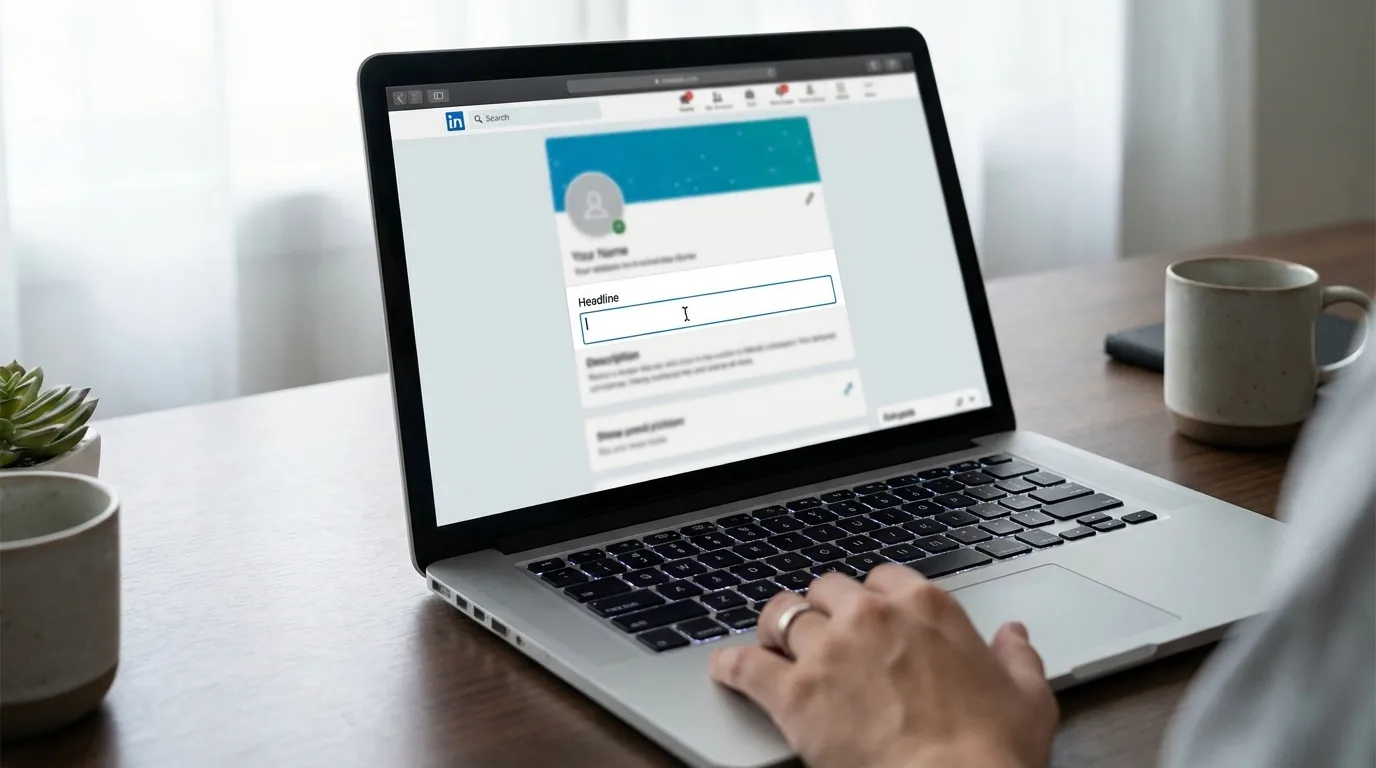
The average LinkedIn profile is a digital CV. It lists jobs, titles, and dates. It has a generic headline that mirrors a job title. It has a summary section that reads like an objective statement from 2009. It has no featured content, no recent activity, and no signal of what the person actually knows, thinks, or can do.
That profile is not bad. It is simply invisible. It does not get found in recruiter searches because the keywords are not there. It does not generate inbound messages because there is no evidence of expertise. It does not attract opportunities because it gives the reader no reason to reach out.
Here is what most people do not realise: LinkedIn's algorithm surfaces profiles in two distinct ways — through search (keyword-driven) and through content (engagement-driven). Most professionals optimise for neither. They leave their profile as a static document and wonder why nothing happens.
The professionals who generate consistent inbound opportunities do both. Their profiles are searchable — optimised for the keywords recruiters use. And they are visible — their content appears in the feeds of people who might hire them, collaborate with them, or refer them, regularly enough to stay top of mind.
This guide covers both.
Part 1: Profile Optimisation — Being Found Before You Are Seen

The headline
Your LinkedIn headline is the most algorithmically important field on your profile. It is indexed by LinkedIn's search engine and appears in every context where your name appears — search results, post comments, connection requests, recruiter searches.
Most people waste it on their job title and employer: "Senior Marketing Manager at Acme Corp." That tells a recruiter what you are. It does not tell them what you do, what you are good at, or whether they should click through.
The formula that works in 2026:
[Role or Expertise] | [Specific Skill or Sector] | [Value Proposition or Availability Signal]
Examples:
"B2B Content Strategist | SaaS & Fintech | Helping Startups Build Organic Pipelines | Open to Senior Remote Roles"
"Data Engineer | Cloud Infrastructure & Real-Time Pipelines | AWS & Snowflake | Open to Remote-First Roles"
"Head of People Operations | Scaling Teams in High-Growth Tech | Remote-First Culture Design"
"UX Researcher | B2C Mobile & E-commerce | Turning User Insight into Product Decisions"
The phrase "Open to Remote Roles" or "Open to Senior Remote Roles" functions as a keyword in recruiter searches. Include it if you are actively looking. Remove it when you are not — but keep the rest of the formula in place.
Change your headline today. It takes five minutes and it changes how the algorithm categorises you.
The About section
Your About section is read by humans, not algorithms — but only if the first two lines earn the click to "see more." Those first two lines must contain your most compelling professional claim, with a specific number or outcome, before the text cuts off.
Structure that works:
Lines 1–2 (before the cut-off): Your role, your specialism, and one quantified achievement. "I help B2B SaaS companies build content pipelines that generate inbound pipeline. In the last three years, I've grown organic traffic from under 10,000 to over 200,000 monthly visits across two companies."
Lines 3–8: What you do specifically, for whom, and with what tools or methodology. Keep it concrete. Avoid mission statements and values. Recruiters and potential collaborators want to know what working with you looks like, not what you believe in.
Lines 9–12: What you are looking for or open to. Be specific: "Currently open to Head of Content and VP of Content roles at remote-first B2B SaaS companies in the $20M–$200M revenue range." Or if you are not actively looking: "I occasionally take on advisory and fractional content leadership engagements. If you're building a content function from scratch, feel free to connect."
Final line: A clear call to action. "Connect, follow, or message me directly — I respond to specific, relevant enquiries."
The Featured section
The Featured section sits directly below your About section and is one of the most underused profile elements on LinkedIn. It allows you to pin up to five items — posts, articles, external links, documents, or media.
Pin three items:
Your best piece of work — a case study, a published article, a portfolio link, a presentation, a Loom walkthrough of a project. The thing that best demonstrates what you do.
Your most-engaged LinkedIn post — the one that got the most comments and reactions. Social proof that you produce content people find valuable.
A specific resource or tool — a template, a framework, a guide that demonstrates expertise. Something a stranger would find immediately useful.
Profiles with a populated Featured section receive 36% more profile views than those without, and recruiter messages increase by an average of 21%, according to LinkedIn's own platform data from 2025.
Skills and endorsements
The Skills section is algorithmically significant — LinkedIn's search function uses endorsed skills as a ranking signal. Add your top 10–15 skills, prioritising those most relevant to your target roles. Then ask three to five colleagues to endorse the most important ones. Endorsed skills rank higher than unendorsed ones in search results.
Remove skills that are not relevant to your current direction. A 2015 endorsement for Microsoft Publisher is not helping your data engineering profile.
Part 2: Content Strategy — Being Seen Before You Are Hired

This is where most guides overcomplicate things. The LinkedIn content strategy that generates professional opportunity does not require daily posting, a content calendar, or a personal brand strategy document. It requires one thing: regularly publishing specific, honest, useful content about your professional area.
That is it. The format, the frequency, the topic — these are all secondary to specificity, honesty, and usefulness.
What to post — and what not to
Post this:
A specific mistake you made and what you learned from it. These perform consistently above average because they are rare — most professionals only share successes. The data engineer's post above is this format.
A process or framework you use that others in your field might find valuable. Not a generic "10 tips" list — a specific thing you actually do, explained with enough detail to be immediately applicable.
A counterintuitive observation about your field. Something that challenges the conventional wisdom, with your reasoning. "Everyone talks about headcount as a measure of engineering team health. Here's why I think it's the wrong metric — and what we measure instead."
A specific project outcome with context. Not a humblebrag announcement — a substantive walkthrough of what the problem was, what you did, and what happened. Include one number.
A genuine question you are wrestling with, directed at people in your network. Questions generate comments; comments drive distribution; distribution builds visibility.
Do not post this:
Motivational quotes. They generate zero professional credibility and attract no relevant professional audience.
Reposts with a thumbs-up emoji and no commentary. The algorithm deprioritises reposts; they also signal that you have nothing to say.
Vague life updates dressed as professional insight. "Excited to announce I'm starting a new chapter!" tells your network nothing useful and generates engagement only from people who already know you.
Generic career advice that could have been written by anyone. "The most important thing in your career is never giving up." Nobody who can hire you or refer you is impressed by this.
Anything that begins with a string of line breaks designed to hide the content until someone clicks "see more." This tactic has been algorithmically penalised since mid-2024 and annoys most readers.
How often to post
Once per week is sufficient for consistent LinkedIn visibility. Twice per week accelerates it. Three or more times per week provides diminishing returns for most professionals and increases the risk of posting content that is not genuinely valuable — which is worse than not posting.
The research is clear on this: LinkedIn's algorithm prioritises engagement rate (comments and reactions as a percentage of impressions) over raw volume. One post per week that generates 50 comments will do more for your profile visibility than five posts per week that generate 10 comments each.
Post when your target audience is online. For most B2B professionals: Tuesday, Wednesday, and Thursday mornings perform best. Specifically, between 7am and 9am in your target time zone. For UK professionals targeting UK audiences, post at 7am–9am GMT/BST. For US audiences, post at 7am–9am EST.
How to write a LinkedIn post that gets read
LinkedIn is a text-first platform. Most posts are read on mobile. This means short sentences, clear structure, and an opening line that earns the next line.
The structure:
Line 1 — the hook. One sentence. It should create either curiosity, recognition, or mild provocation. "We shipped a feature nobody asked for. It became our most-used tool within 30 days." or "I've reviewed 400 CVs in the last 18 months. Here's what 90% of them are missing." The hook does not need to be clickbait. It needs to be honest and specific enough to make a relevant reader want to continue.
Lines 2–4 — the setup. The context. What was the situation? Keep it brief — two to three sentences that give the reader enough background to care about what comes next.
Lines 5–12 — the substance. The actual content. What happened, what you did, what you learned, what the framework is, what the data shows. This is where the value lives. Be specific. Use numbers where you have them. Write in plain sentences, not bullet points — bullets on LinkedIn often signal "I ran out of things to say."
Lines 13–15 — the takeaway. One or two sentences that crystallise the point. Not a call to action to follow you or visit your website. The takeaway that a reader could act on immediately.
Optional final line — the question. "What do you do differently?" or "Has anyone else seen this pattern?" A genuine question generates comments, which drive distribution. Do not fake it — only ask if you are actually curious about the answer.
Engaging with other people's content
Posting is half the strategy. Engaging is the other half — and most people neglect it entirely.
Leave substantive comments on posts from people in your target industry, your target companies, and your target role level. Not "Great post!" — a two to three sentence response that adds a perspective, asks a follow-up question, or shares a related experience. Your comment appears on the post, is visible to everyone who sees it, and links back to your profile.
A consistent commenter on relevant content becomes a recognisable name in a professional community faster than a consistent poster. Both work better together.
Target five to ten posts per week to comment on substantively. This takes 20–30 minutes if you batch it. It builds profile visibility and network relationships simultaneously.
Part 3: Network Building — The Architecture of Inbound Opportunity

A LinkedIn personal brand without a relevant network is a billboard in a field. The distribution of your content depends on who sees it first — and that depends on who is in your network.
Build your network with intention, not volume.
The LinkedIn profiles that generate consistent professional opportunity have networks built around three concentric circles:
Inner circle (500–1,500 connections): Current and former colleagues, clients, collaborators, and professional contacts you have actually interacted with. These are the people who will like and comment on your posts, amplifying them to their networks. Quality matters far more than quantity here.
Middle circle (1,500–5,000 connections): People in your target industry, at target companies, and in target roles — whether or not you have met them. Connected through shared events, shared content, or deliberate outreach. These are the people who may hire you, refer you, or become clients.
Outer circle (5,000+ connections): Broad network built through content visibility and engagement. Useful for reach but less valuable for direct opportunity than the inner and middle circles.
How to build the middle circle deliberately:
Connect with 5–10 people per week from your target industry. Use LinkedIn's search filters: industry, job title, company, location. Send a connection request without a note — accepted at higher rates than requests with messages.
After connecting, engage with their content once or twice over two weeks. Then, if relevant, send a message: "Your post about [specific topic] resonated — I've been dealing with something similar. Would love to connect more directly if you're open to it."
Follow thought leaders in your target industry and engage consistently with their content. This builds visibility in the communities you want to be known in.
The one metric that matters:
Profile views per week. Check it every Monday. If it is growing week-over-week, your content and network strategy is working. If it is flat or declining, something needs to change — usually either posting frequency, content specificity, or network expansion.
US vs UK: How LinkedIn Culture Differs

The platform is global. The professional norms are not.
US LinkedIn culture trends toward higher volume content, more personal storytelling, and a greater tolerance for self-promotion. US professionals are more likely to post about career milestones, share salary information publicly (partly driven by the pay transparency movement), and engage in broad professional debates. The audience is larger and the algorithm rewards volume more than in the UK.
UK LinkedIn culture is more reserved. Overt self-promotion is received less warmly, and content that would read as confident in the US can read as arrogant in the UK. The most effective UK LinkedIn content is specific, understated, and expertise-driven rather than personal-brand-driven. Salary transparency is growing in the UK — driven partly by EU pay transparency regulations coming into force in 2026 for UK companies with EU operations — but is still less normalised than in the US.
Practical implications:
If you are building a UK-facing personal brand, lead with expertise and be precise about the professional value you deliver. Avoid the LinkedIn formats popular in the US that feel performative to a UK audience — the emotional career journey post, the humble-brag milestone announcement, the inspirational quote with a personal story attached.
If you are building a US-facing brand from the UK, you can be slightly more direct about your professional achievements and availability than you might be on a UK-focused profile. US audiences read directness as confidence rather than arrogance more readily than UK audiences.
Salary and compensation:
LinkedIn's 2025 Salary Insights tool now allows professionals to see salary bands for their role and seniority level by geography — including remote roles. Use this data to benchmark your compensation before any negotiation. In the UK, this is particularly useful for understanding the London-premium (typically 10–20% above UK regional rates for equivalent roles) and the remote discount (5–10% reduction from London-rate roles advertised as UK-wide remote).
What Most People Get Wrong
They post about their career instead of their expertise. LinkedIn content that generates professional opportunity is not about you — it is about the knowledge you have that is useful to someone else. The announcement post ("Excited to share that I've joined...") gets likes from your existing network. The expertise post ("Here's what I've learned about managing distributed engineering teams after 4 years of doing it...") gets messages from people who want to hire you.
They optimise for followers instead of the right followers. A post that goes viral among junior professionals is not the same as a post that gets read by three senior people at your target companies. Know who you are writing for. Distribution to the right 500 people is worth more than distribution to the wrong 50,000.
They treat LinkedIn as a job board. Professionals who only update their LinkedIn profile and activity when they are actively job searching are always starting from zero. The personal brand that generates inbound opportunity is built during the periods when you are not looking — so that when you are, the infrastructure already exists.
They give up after four weeks. LinkedIn content compounds. The first four weeks of consistent posting rarely produce dramatic results. The results arrive at week 8, week 12, and beyond — as your network grows, your engagement rate builds, and your profile accumulates the kind of consistent activity that the algorithm rewards. Most people stop before the compounding begins.
They confuse connection count with network quality. 15,000 connections who are not in your target industry generate less professional opportunity than 800 connections who are exactly the people you want to know. Grow your network with intention, not with volume.
Real-World Example: From Invisible to Inbound in 90 Days
Fatima, a senior compliance consultant with 13 years of experience, had 640 LinkedIn connections and had not posted in 18 months. Her profile listed her job title, employer, and a list of bullet points copied from her job description. She received zero recruiter messages in a typical month.
Over 90 days, she made the following changes:
Month 1: Rewrote her headline to "Senior Compliance Consultant | Financial Services Regulation | GDPR & AML | Open to Remote Advisory Roles." Rewrote her About section with a specific opening line: "I've helped 14 financial services firms avoid regulatory fines totalling over £23 million in the last six years. Here's what most of them had in common before I arrived." Pinned three Featured items: a LinkedIn article she had written 18 months earlier, a link to a podcast she had appeared on, and a one-page PDF guide she created on GDPR documentation proven approaches.
Month 2: Posted once per week. Week 1: a specific case study (anonymised) of a compliance failure she had helped remediate. Week 2: a counterintuitive observation about how most firms misunderstand AML obligations. Week 3: a framework she used for compliance risk assessments. Week 4: a question to her network about the most common regulatory misunderstanding they encountered.
Month 3: Maintained posting frequency. Began engaging substantively with five to eight posts per week from people in her target community — senior compliance officers, fintech founders, legal directors. Connected with 40 new people in her target industry.
Results at 90 days: profile views up from an average of 12 per week to 340 per week. LinkedIn follower count up from 640 to 1,840. Inbound recruiter messages: 3 per week (up from 0). One unsolicited approach from a fintech scale-up about a fractional Chief Compliance Officer engagement at £1,200 ($1,500) per day — which she accepted for two days per week alongside her existing work.
She did not go viral. She was simply visible, specific, and consistent.
The Data That Makes the Case
LinkedIn's 2025 Platform Insights report found that professionals who post at least once per week receive 5.6 times more profile views than those who post monthly or less. Profiles with a complete Featured section and a keyword-optimised headline receive 3.2 times more recruiter messages than those without. And professionals who engage (comment and react) with at least 10 posts per week in their target professional community see inbound connection requests from target-adjacent professionals increase by an average of 47% within 60 days.
The numbers compound. Start now, not when you need it.
Three Takeaways and One Specific Action
Key takeaways
Your LinkedIn profile is your primary recruitment surface in 2026 — not your CV. A keyword-optimised headline, a specific and forward-facing About section, and a populated Featured section will generate more inbound opportunity than any application you submit.
The content formula is not complicated: specific, honest, useful. One post per week that demonstrates what you know — not who you are, not what you have achieved — builds professional visibility that compounds over months, not days.
Engagement is as important as posting. Substantive comments on five to ten relevant posts per week build network relationships and profile visibility simultaneously. The professionals who combine posting and engaging consistently outperform those who do either alone.
Your action this week: Rewrite your LinkedIn headline using the formula: [Role or Expertise] | [Specific Skill or Sector] | [Value Proposition or Availability Signal]. Then write one LinkedIn post — 150–280 words — about one specific thing you have learned or observed in your professional life in the last 90 days. Post it on Tuesday or Wednesday morning. That is the start.
This article reflects general trends and market data as of April 2026. Always verify current LinkedIn platform features, salary benchmarks, and employment law requirements in your region before making career decisions.