
You stream a 4K film on the train. Ask an AI assistant to summarise your emails. Your phone automatically backs up 47 photos from the weekend. All of this happens in about 90 seconds, most of it without you thinking about it.
What actually made that possible is not magic. It's a specific combination of three infrastructure layers — 5G, cloud computing, and AI — that have converged in 2026 in ways that weren't technically feasible three years ago. Understanding what each layer does, and how they depend on each other, tells you something important about why your services sometimes fail, what the real cost of AI is, and what the next set of infrastructure changes will mean for your bill.
The Infrastructure in Plain English
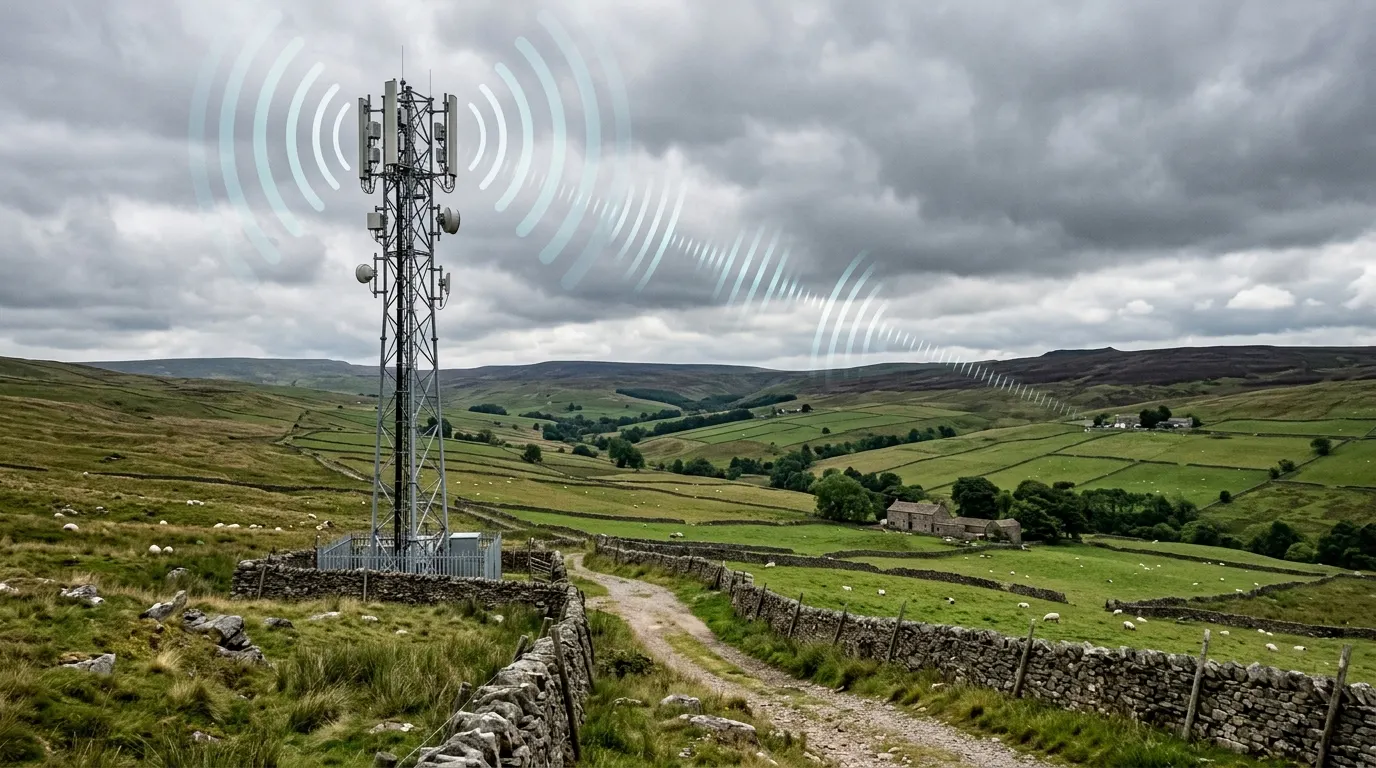
Think of it as three layers of a modern city.
5G is the road network.
It carries data between your device and everything else, faster and with lower latency than 4G. Low latency — the gap between sending a request and getting a response — is what makes real-time applications feel responsive. 5G targets latency below 10 milliseconds in ideal conditions, compared to 30–50ms on 4G. For video calls, that's the difference between feeling live and feeling laggy.
Cloud computing is the warehouse district.
The actual storage and processing of most digital services happens in massive data centres operated by a handful of companies — primarily Amazon (AWS), Microsoft (Azure), and Google Cloud. When you use any major app, you're almost certainly talking to servers in one of these facilities. The app on your phone is usually just an interface; the intelligence lives elsewhere.
AI is the warehouse management system.
It decides how requests are routed, predicts what resources will be needed, personalises what you see, and — increasingly — generates the content itself. AI doesn't run independently; it runs on cloud infrastructure, delivered to you via the connectivity layer. The three are deeply interdependent.
Why This Matters More in 2026 Than It Did in 2023
The energy cost of AI is now a national infrastructure issue. That's not hyperbole.
US data centres consume approximately 176 TWh of electricity annually as of early 2026, representing about 4.4% of total US electricity consumption. Tech Insider Global electricity consumption from data centres is projected to double to reach around 945 TWh by 2030 — just under 3% of total global electricity consumption. IEA
To put that in terms that land: a typical Google search uses approximately 0.3 watt-hours of electricity. A ChatGPT query uses approximately 2.9 watt-hours — roughly ten times more. Data Center Frontier When that scales to millions of queries per hour, the infrastructure implications are enormous.
But here's the thing most infrastructure coverage misses: this energy cost is invisible to users because it's bundled into subscription prices and advertiser revenue. When you use a "free" AI tool, you're not paying for the electricity. Someone else is — and that someone is increasingly asking governments for help funding grid expansion.
The 5G side of the equation is more prosaic but directly relevant to UK and US consumers. 5G is significantly more energy-efficient per bit of data transmitted than 4G — but the projected 1,000-fold increase in data traffic and the proliferation of new edge data centres could lead to a substantial rise in the industry's overall energy consumption. Datacentremagazine Efficiency per transaction doesn't help if you do exponentially more transactions.
Testing It: Picking a Cloud Provider for a Small Business

I spent two weeks evaluating the four major cloud providers for a specific use case: a ten-person UK professional services firm wanting to store client documents, run a simple AI-assisted search tool, and ensure data stays within the UK.
AWS (Amazon Web Services): Set up a UK-region S3 bucket in about 12 minutes. Adding an AI document search layer via Bedrock took a further 40 minutes, most of it reading documentation. The free tier is genuinely useful for testing. But the pricing model — pay-per-request, pay-per-GB transferred, separate charges for every service component — made predicting monthly costs genuinely difficult without building a detailed usage model first.
Microsoft Azure: Directly integrated with Microsoft 365, which the firm already used. Took 8 minutes to connect SharePoint to Azure AI Search. The billing, similarly complex, but the integration removed friction that would have required custom development on AWS. Straightforward UK data residency options — the UK South and UK West regions are explicitly flagged and available.
Google Cloud: The strongest AI tooling of the three, particularly for document understanding. UK data residency available. But for a firm not running on Google Workspace, there's less native integration benefit.
Cloudflare: Not a full hyperscaler but genuinely worth considering for firms that primarily need edge performance and security rather than storage and compute. The free tier handles substantial traffic. Global network with UK presence.
Honest verdict: For a UK small business already on Microsoft 365 — Azure is the correct default. The data residency, the M365 integration, and the predictable enterprise pricing structure all point the same direction. For a tech-forward startup without existing ecosystem commitments — AWS offers the widest tooling, and the initial complexity is a manageable learning investment.
The Cloud Provider Comparison
Provider | Best For | Free Tier | Pricing Model | UK Data Residency | AI Integration |
|---|---|---|---|---|---|
AWS | Maximum flexibility, largest toolset | 12-month free tier on core services | Pay-per-use (complex) | ✓ EU-West-2 (London) | Bedrock, SageMaker |
Microsoft Azure | Microsoft 365 organisations, enterprise compliance | Limited but available | Consumption + reserved instance options | ✓ UK South + UK West | Azure OpenAI, Copilot Studio |
Google Cloud | AI-first workloads, Google Workspace firms | $300 credit for 90 days | Pay-per-use | ✓ EU/UK regions | Vertex AI, Gemini API |
Cloudflare | Edge performance, security, lightweight compute | Generous — handles high traffic | Per-request above free limits | ✓ Global edge with UK presence | Workers AI (on-edge inference) |
The UK and US Infrastructure Gap

The UK and US are in meaningfully different infrastructure positions in 2026, and it affects how both 5G and cloud services perform in practice.
5G coverage: In the US, the major carriers — Verizon, AT&T, T-Mobile — have deployed 5G broadly but unevenly. Rural coverage remains patchy. In dense urban areas, millimetre-wave 5G delivers genuinely significant speeds — averaging 1–4 Gbps in optimal conditions. In the UK, EE, Vodafone, O2, and Three have 5G available in major cities. UK coverage outside major urban centres remains significantly limited.
Full-fibre broadband: This is where the UK story is more interesting. The UK government's full-fibre rollout is accelerating — Openreach passed 15 million premises with FTTP (Fibre to the Premises) by late 2025, up from 11 million a year earlier. For fixed broadband, this is meaningfully faster and more reliable than the part-copper infrastructure it replaces.
Data sovereignty: GDPR applies to UK organisations handling data from EU citizens, even post-Brexit, under the UK GDPR framework enforced by the ICO. The practical implication: if your cloud provider stores data in US servers by default, you need to actively configure UK or EU data residency — it's not automatic on any of the major platforms. All four providers above support this, but it requires deliberate setup.
What This Means for Your Monthly Bill
The energy costs of AI infrastructure are beginning to filter through to consumers, but not in obvious ways.
In 2025 alone, an estimated $580 billion was spent globally on AI-focused data centre infrastructure. TTMS That capital expenditure will be recovered through subscription pricing, advertising rates, and enterprise contracts. Free AI tiers exist because they generate training data and user lock-in, not because the compute is cheap to provide.
The direct consumer impact: electricity prices in regions with high data centre concentration — Virginia, Texas, and parts of England — are rising partly due to grid infrastructure costs being socialised across ratepayers. Virginia, which hosts the world's largest data centre concentration, accounts for 24 TWh of annual data centre electricity consumption. Tech Insider Residents there are already seeing this reflected in utility bills.
It's not a reason to avoid cloud services. It's a reason to understand what you're actually using when you do.
Conclusion
5G, cloud, and AI are not separate technologies — they're a single infrastructure system.
Disruption to any layer affects all three. The Middle East energy shock in early 2026 affected cloud pricing and AI tool availability because data centres run on energy, full stop.
For UK businesses: data residency is not automatic.
Every major cloud provider offers UK-region options, but you have to configure them explicitly. The default is often US-based infrastructure with GDPR implications.
The energy cost of AI is real and it's heading towards consumers.
Free tiers won't last forever at current compute costs. Understand what you use, and why, before those costs become visible on your bill.
Your next action: If your business uses any cloud storage or SaaS tools, spend 30 minutes this week checking where your data is stored. Most business accounts have a settings page showing data region. If it's US-only on a tool handling EU or UK customer data, that's a conversation to have with your IT lead or legal team before the ICO raises it first. AWS UK South region, Azure UK South, and Google Cloud europe-west2 (London) are all viable. The question is whether anyone has actually configured them.