
An AI system trained on satellite imagery detects illegal deforestation in the Amazon within 24 hours of it happening. Not through a human analyst reviewing thousands of images — that would take weeks. The AI compares daily satellite passes to baseline imagery, flags anomalies consistent with deforestation patterns, and pushes an alert to rangers on the ground within hours. Before the equipment has been moved. Before the loggers have dispersed.
This is Rainforest Connection's Acoustic Guardians system, expanded into visual monitoring in 2024. It operates across millions of acres of protected forest. It's funded partly by tech philanthropy, partly by conservation organisations, and partly by carbon credit markets. It's genuinely operational and it's genuinely working.
That's the honest starting point for any discussion of AI and global challenges in 2026. Not every AI-for-good project delivers what it promises — most don't, because the problems are harder than the marketing suggests. But some do, in specific, measurable ways, and understanding which ones and why tells you something important about both the technology and the conditions under which it succeeds.
This article focuses on what actually works, what it costs, what the risks are, and how individuals and organisations can connect with it — rather than what sounds compelling in a press release.
The Real Promise — And the Real Paradox
The honest framing of AI for global good in 2026 requires acknowledging an uncomfortable paradox upfront.
The AI solutions proposed to address global health concerns are exacerbating the very health problems they purport to address. AI technologies exacerbate climate change and sociopolitical instability due to their intensive use of natural and energy resources linked to the training and deployment of algorithmic systems. The Lancet
US data centres consume approximately 176 TWh of electricity annually as of early 2026, representing about 4.4% of total US electricity consumption. Tech Insider Training a single large AI model generates carbon emissions comparable to flying multiple return transatlantic flights. The energy cost of the AI systems designed to solve climate change is itself a meaningful climate cost.
This paradox doesn't make AI-for-good work worthless — but it does mean that the most credible projects are the ones that have thought carefully about efficiency, that use smaller models where large models aren't necessary, and that are honest about their environmental footprint alongside their social impact.
Projects like Google's flood forecasting system and Dryad's wildfire detection network demonstrate how technology can work together with human skills to protect communities by making early predictions. Different fields are applying AI — waste management with Greyparrot, biodiversity monitoring with Wildbook — in ways that demonstrate creative solutions with measurable impact. ECOSKILLS
The projects worth highlighting are the ones with verifiable impact data, not just compelling mission statements.
Meet Dr Fatima: AI-Assisted Diagnosis in Rural Kenya
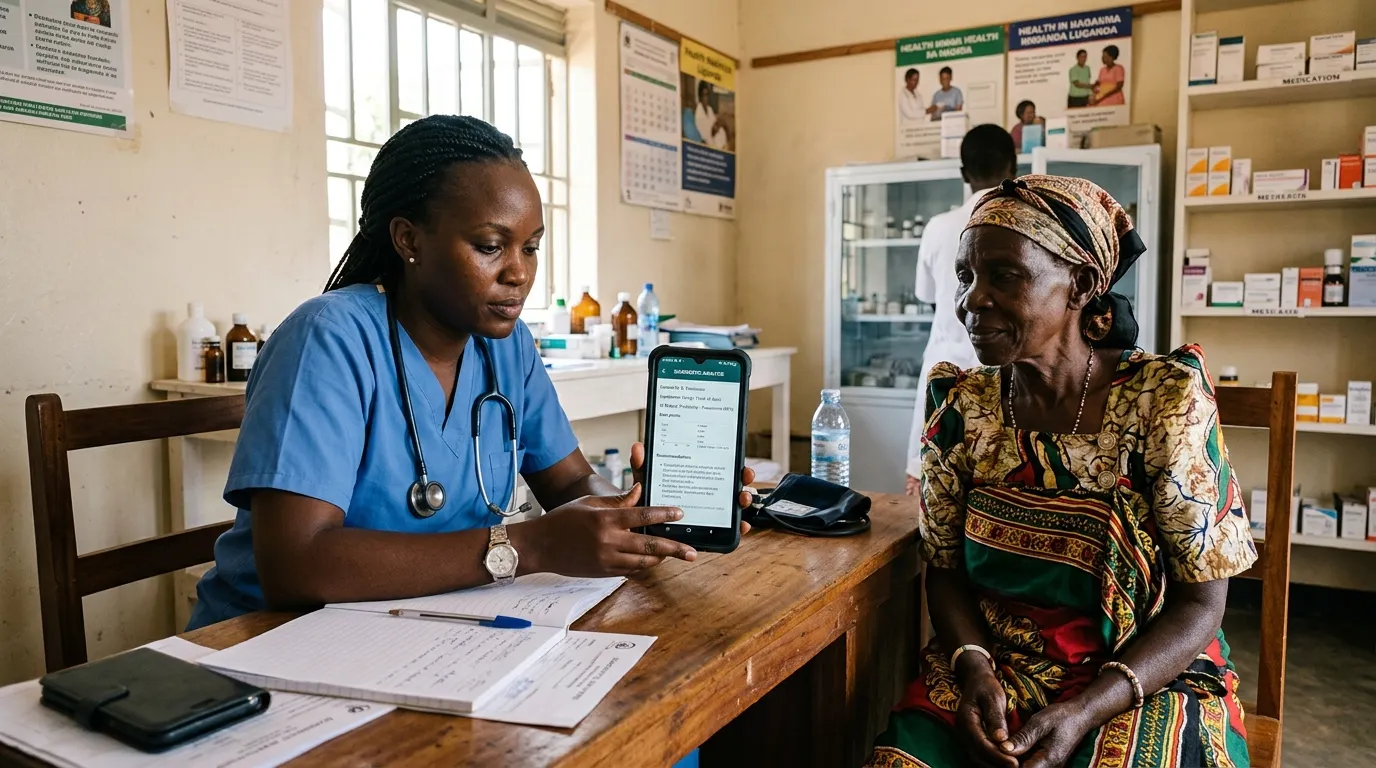
Dr Fatima is a doctor working at a rural health clinic in western Kenya, approximately 120 kilometres from the nearest specialist hospital. Her clinic sees 80–100 patients per day. She has no radiologist, no cardiologist, no oncologist. She has a smartphone, an internet connection that works most of the time, and — since early 2025 — access to AI-assisted diagnostic tools developed by Flatiron Health and Kenyatta National Hospital in partnership with Google's AI for Health programme.
The most impactful tool in her daily practice: an AI model that analyses photos of skin lesions taken with a standard smartphone camera and provides a differential diagnosis with confidence scores. Trained on over 600,000 dermatological images including a substantial proportion from Sub-Saharan African patients (a demographic historically underrepresented in medical AI training data), it identifies suspicious lesions with sensitivity and specificity that, in clinical validation trials, exceeded that of non-specialist doctors.
"Before this, a patient with a suspicious lesion had two options," she told me. "Wait months for a referral to Nairobi. Or do nothing. Now I have a third option: the AI tells me whether this warrants urgent referral or monitoring, and I can make that clinical decision with better information."
The tool doesn't replace her judgement. It augments it with access to pattern-recognition capabilities that would otherwise require a specialist she doesn't have.
This is what genuinely scalable AI-for-health looks like in 2026: not replacing doctors, but giving non-specialists access to the pattern recognition capabilities of specialists, in places where specialists don't exist.
Five AI-for-Good Projects With Verifiable Impact
1. Google DeepMind — Weather and Flood Forecasting
Google DeepMind's GraphCast model, deployed in partnership with the European Centre for Medium-Range Weather Forecasts (ECMWF), produces 10-day global weather forecasts in under one minute on a single TPU — compared to the hours required by traditional numerical weather prediction models. The accuracy equals or exceeds traditional methods on most metrics.
The humanitarian application: in regions with high flood risk — Bangladesh, Pakistan, sub-Saharan Africa — 72-hour advance warning of flood events saves lives and allows asset protection that significantly reduces economic damage. Google's flood forecasting system now covers over 80 countries. Google Research's AI has been advancing climate science and tackling difficult problems, making a tangible difference — demonstrating AI's potential to build towards better climate resilience. Google Research
Verifiable impact: Bangladesh Flash Flood Warning System covered 40 million people by 2025, with documented reductions in casualties in flood events where warnings were issued with adequate lead time. Funding: Google.org, ECMWF, government partnerships. Openness: GraphCast model weights and code are open source, available on GitHub.
2. Rainforest Connection — Acoustic and Visual Forest Monitoring
Rainforest Connection places solar-powered acoustic monitoring devices in forest canopies, running edge AI models that distinguish between chainsaw sounds, truck engines, gunshots, and natural forest sounds in real time. When illegal logging sounds are detected, alerts go to rangers within minutes.
The visual monitoring extension — using satellite imagery and computer vision — covers areas where physical device deployment isn't feasible.
Verifiable impact: Active deployments in Amazon, Congo Basin, and Borneo. Partner rangers credit the system with disrupting active logging operations that would not have been caught through periodic patrol-based monitoring. Funding: Google.org grant, Nia Foundation, individual donations. How to get involved: The organisation accepts volunteer data labelling contributions at rfcx.org — helping label acoustic data used to improve model accuracy.
3. 20tree.ai — Deforestation and Land Use Change Detection
20tree.ai processes satellite imagery at scale to detect deforestation, land use change, and illegal clearing across global forest regions. Unlike systems that rely on high-resolution satellite passes (expensive, infrequent), it uses combinations of optical and radar imagery to maintain coverage even through cloud cover — a significant practical advantage for tropical forests.
The system is used by governments, NGOs, and carbon credit verification bodies to assess whether protected forests are actually being protected.
Verifiable impact: Used by carbon market standards organisations to validate forest carbon credits — directly reducing the occurrence of fraudulent credits that would otherwise dilute the environmental value of the market. Funding: Commercial model (government and corporate clients) supplemented by grant funding for developing-world deployments. Openness: Not open source, but methodology published in peer-reviewed literature.
4. Microsoft AI for Health — Medical Research Acceleration
Microsoft's AI for Health programme provides free compute resources, AI tools, and technical expertise to non-profit and academic health research organisations. Notable applications:
Accelerating pandemic response modelling during COVID-19
AI-assisted protein structure prediction for neglected tropical diseases
Analysis of electronic health records across large populations to identify previously undetected risk factors for chronic conditions
In healthcare, AI algorithms are revolutionising diagnostics and patient care, offering personalised treatment plans by analysing medical records and imaging data. Greenly
Verifiable impact: Multiple published peer-reviewed studies across partner organisations. The protein folding work — building on the foundation established by DeepMind's AlphaFold — has directly accelerated drug target identification for diseases including malaria and tuberculosis, where commercial drug development incentives are insufficient. How to apply: Non-profits and academic medical institutions can apply for compute grants at microsoft.com/en-us/ai/ai-for-health.
5. Zipline — Medical Drone Delivery
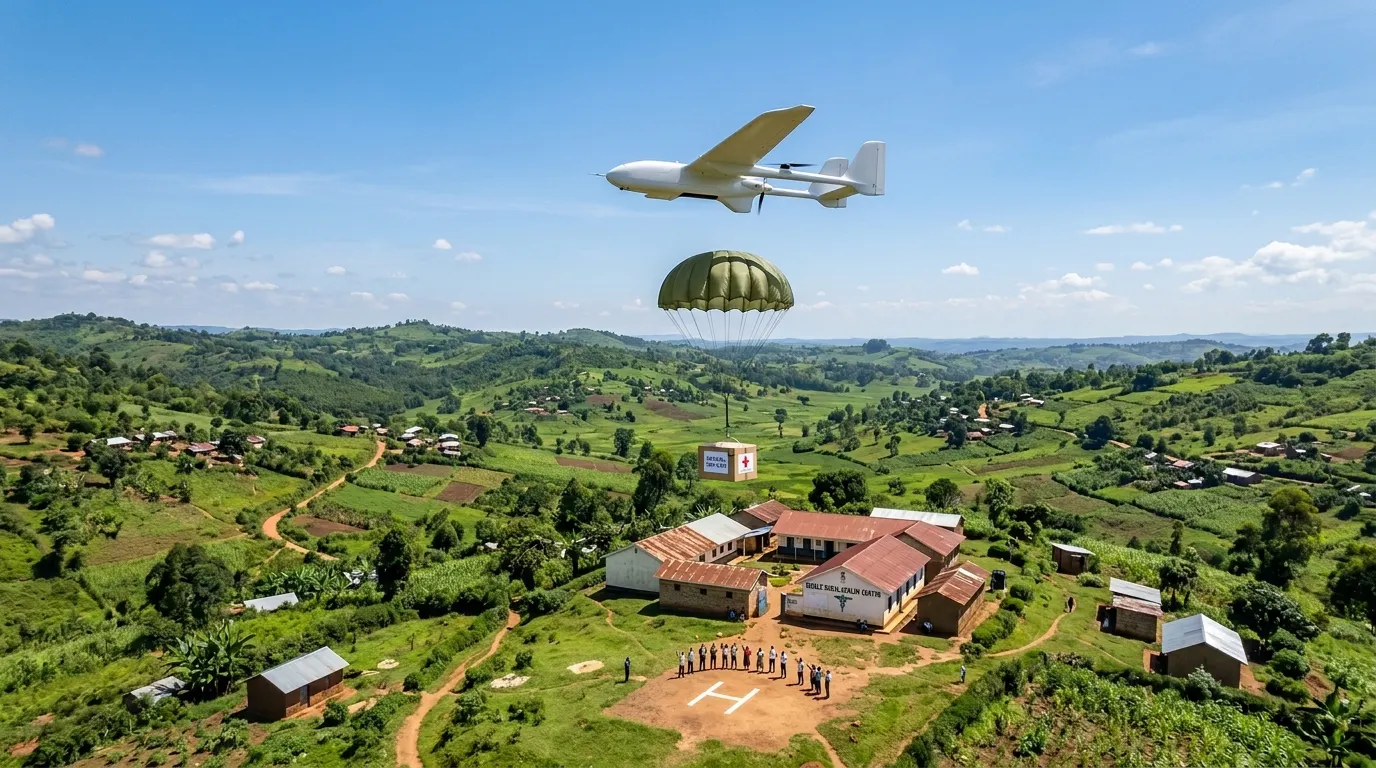
Zipline builds and operates autonomous drone delivery systems for medical supplies — blood products, vaccines, medications — in regions where road infrastructure makes conventional supply chains unreliable.
Operating in Rwanda, Ghana, Nigeria, Kenya, and the US (for corporate medical facility supply chains), Zipline has completed over one million commercial deliveries as of 2026. The AI systems handle autonomous flight planning, weather assessment, and delivery accuracy (landing packages within two metres of a target from cruising altitude).
Verifiable impact: Rwanda's national blood transfusion service reports that Zipline deliveries have contributed to reductions in maternal mortality rates in areas served — by ensuring blood products arrive within 30 minutes of a clinical request rather than hours via road. Funding: Commercial (government contracts) plus investment. UK relevance: NHS supply chain pilots in remote Scottish Highland communities are in early-stage assessment as of 2026.
The Platform Comparison: Where to Find Credible AI-for-Good Projects
Organisation | Focus | Openness | How to Engage | UK/US Availability |
|---|---|---|---|---|
Google.org / Google AI for Social Good | Climate, health, crisis response | Open model releases + grants | Grant applications at google.org | Global — UK organisations eligible |
Microsoft AI for Health | Medical research, pandemic response | Free compute grants | Application at microsoft.com/ai-for-health | Global — UK academic/non-profit eligible |
Rainforest Connection | Deforestation, acoustic monitoring | Open data contributions | Volunteer at rfcx.org | Global volunteer contributions |
Hugging Face | Open model hosting, AI democratisation | Fully open | Host/contribute models, datasets | Global |
AI2 / Allen Institute | Open research AI | Open source (OLMo, etc.) | Open datasets, model access | Global |
Zipline | Medical logistics | Commercial + impact reporting | Partner/fund via government procurement | UK pilot stage; US commercial |
What Actually Makes AI-for-Good Projects Succeed — and Why Most Don't

Here's what most coverage of AI for social good gets wrong: it treats technology selection as the primary challenge. It isn't. The primary challenge is the same as any complex intervention in a human system: problem understanding, local context, and stakeholder alignment.
The projects above succeed for reasons that have as much to do with organisational design as technological capability:
They defined the problem before the solution. Rainforest Connection started from rangers describing the practical problems they had detecting illegal logging — not from an AI team deciding acoustic monitoring would be a good application. The technology was designed around a clearly defined operational need.
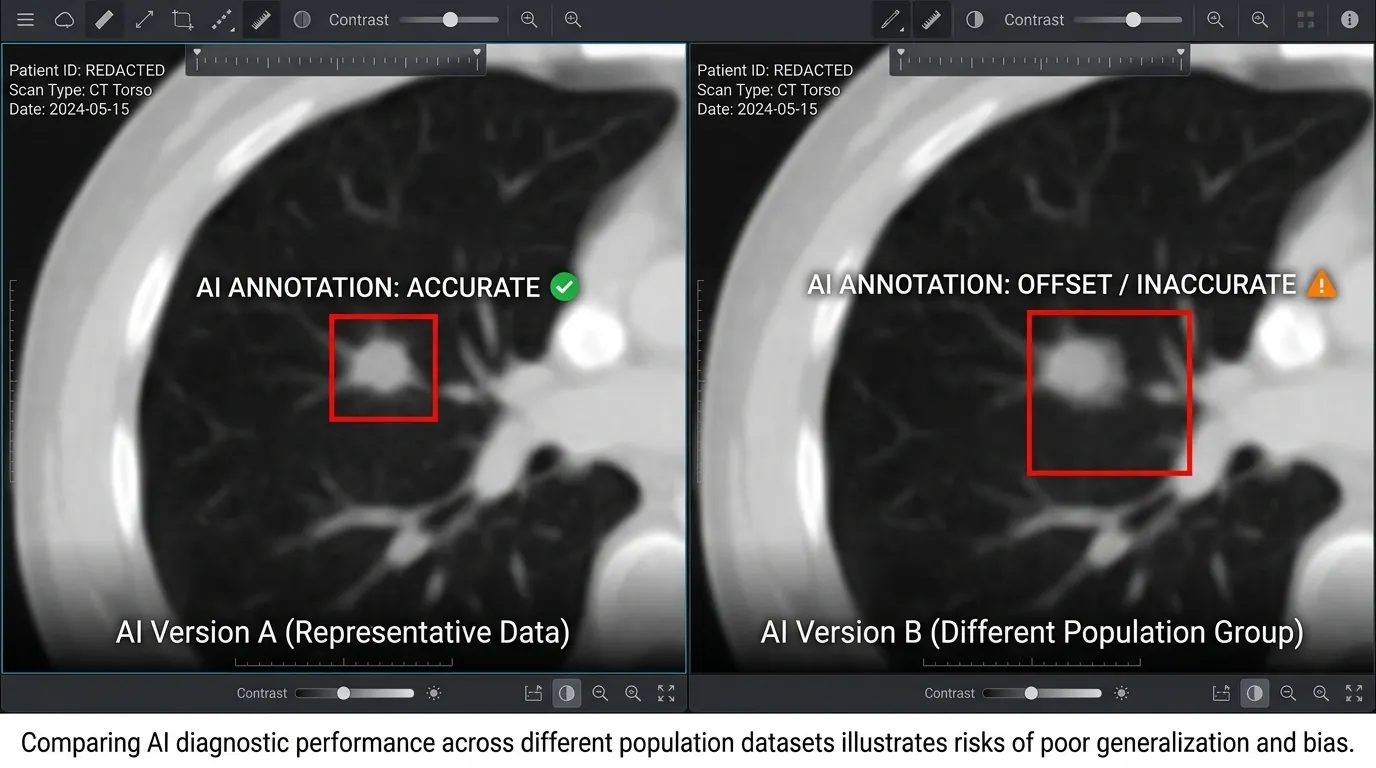
They partnered with domain experts who were also end users. Dr Fatima's diagnostic tool was developed with extensive participation from Kenyan clinicians — not validated primarily on Western patient data and then deployed. The representation problem in medical AI training data is well-documented: models trained predominantly on European and North American patient populations perform worse on patients of other ethnicities, and models trained predominantly on wealthy-country clinical settings fail in contexts where equipment, disease prevalence, and clinical presentation differ.
They measured what matters, not what's easy to measure. Zipline reports on delivery times and medical outcomes, not on drone flight hours or package volumes. Rainforest Connection reports on successful interceptions of illegal logging events, not on alerts generated.
The AI-for-good projects that fail — and there are many, they just generate less press coverage — typically share a different profile: technology-first design that discovers the problem afterwards, limited involvement of the communities affected, optimisation for metrics that look good in grant reports rather than metrics that reflect actual impact, and insufficient consideration of how the technology could be misused or cause unintended harm.
The Risks Nobody Talks About Enough
The honest discussion of AI for global challenges must include the risks of AI-for-global-challenges, because they are real and significant.
Algorithmic bias in humanitarian contexts: AI systems trained on data that underrepresents certain populations will perform worse for those populations. In healthcare, this can mean diagnostic accuracy that's systematically lower for patients of certain ethnicities. In agriculture, it can mean crop advisory systems that reflect conditions in large-scale commercial farming rather than smallholder plots. In financial inclusion, it can mean credit scoring that disadvantages people without formal credit histories — the very people that financial inclusion programmes are meant to serve.
Surveillance risks in conflict zones: AI-enabled surveillance technology — facial recognition, acoustic monitoring, satellite tracking — can be deployed by authoritarian governments as easily as by conservation organisations. The same AI that tracks illegal loggers can track political dissidents. The same acoustic AI that detects chainsaws can detect crowd gatherings. Before deploying AI surveillance capabilities in any context involving political risk, the dual-use question is not optional.
Data sovereignty for vulnerable populations: When AI systems are deployed to serve communities in low-income countries, those communities often have no visibility into how their data is used. Health data from patients in Rwanda trains models that generate commercial value primarily for organisations based in the US or EU. The communities generating the data rarely receive the benefits of the resulting models, and rarely have meaningful consent mechanisms that give them genuine control over how their data is used.
These aren't arguments against AI for good. They're arguments for doing it with greater rigour, more inclusive design processes, and more honest accounting of both benefits and risks.
How Individuals Can Contribute
You don't need to be an AI researcher to contribute meaningfully to tech-for-good projects. The bottleneck in most of these projects is not AI talent — it's domain expertise, local context knowledge, and the unglamorous work of data labelling and validation.
Data contribution: Hugging Face hosts open datasets that anyone can contribute to. Many AI-for-good projects publish their training data for public contribution — wildlife image labelling, medical image annotation, language model training for underrepresented languages.
Volunteer computing: The BOINC distributed computing network allows individuals to contribute unused CPU/GPU cycles to scientific research computing — climate modelling, protein structure prediction, astrophysics. folding@home specifically focuses on disease research.
Funding: Google.org, Microsoft philanthropies, and the Wellcome Trust all run accessible grant programmes. The Wellcome Trust's data for science and health programme specifically funds projects using AI and data science for health impact in low- and middle-income countries.
Professional skills: If you have data science, cloud infrastructure, or software engineering skills, organisations including DataKind and Statistics Without Borders match technical volunteers with non-profit data projects. DataKind (datakind.org) has active UK and US chapters.
Conclusion: Three Things Worth Taking Away
Key takeaways
The AI projects that genuinely work are the ones that started from a defined human problem, not from the technology. Rainforest Connection worked because it started from rangers describing what they needed. Zipline works because it's solving a real logistics problem that has a clear market. The AI-for-good projects that fail almost always start from the technology and work backwards to the problem.
The environmental cost of AI is itself a global challenge. The energy consumed by AI training and inference is growing faster than renewable generation can replace it. Credible AI-for-good projects have an obligation to account for their environmental footprint — using the most efficient models for the task, minimising unnecessary training runs, and being honest about their energy consumption.
The most impactful AI-for-good contribution most people can make isn't funding or volunteering — it's demanding better. Better data representation. Better community involvement. Better measurement of real outcomes vs vanity metrics. Better honesty about when AI isn't the right tool. The global challenges are real. The technology is increasingly capable. The gap between capability and genuine impact is mostly a design problem — and design problems are solvable when people with domain knowledge push back on technology-first thinking.
Your next action: Visit huggingface.co/datasets and search for a dataset in a domain you have knowledge of — medical, legal, agricultural, environmental. If the data quality or representation could be improved by someone with your expertise, contribute. Most open datasets have contribution guidelines. The models that will solve global challenges in five years are being trained on data being collected and labelled today.