
A boiler in a semi-detached house in Sheffield sent an alert three days before it failed. Not to the homeowner. Directly to the heating engineer, who arrived the following morning, replaced a failing pump component, and left before the family had any idea there'd been a problem. The boiler hadn't made a sound. The leak was five days away from becoming significant. Nobody noticed it — except the sensor in the control unit, which had been monitoring pressure variance for six months and detected a pattern consistent with pump bearing wear.
This is already happening. Not in a tech demo. Not in a pilot programme. In a standard new-build home in the north of England, connected to a building management system that cost the developer approximately £200 to integrate per unit.
That's the actual state of IoT in 2026. Not the science fiction version — not the fridge that orders milk or the house that knows when you're upset. The real version, which is quieter, less glamorous, and considerably more useful. Sensors that detect problems before they become crises. Thermostats that learn your patterns without you programming anything. Streetlights in Manchester that dim automatically when no one's around and brighten when they detect movement. Logistics warehouses where conveyor belt failures are predicted days in advance using vibration data from embedded sensors.
The number of connected IoT devices globally grew 14% to 21.1 billion in 2025, with IoT Analytics estimating those connected devices could reach 39 billion by 2030. Expanded Ramblings That number is large enough to be meaningless in isolation. What matters is what those devices are doing, what data they're collecting, and — particularly for UK and EU consumers — where that data goes.
This article explains all of it, without the marketing spin.
What IoT Actually Means — And What AI Adds to It
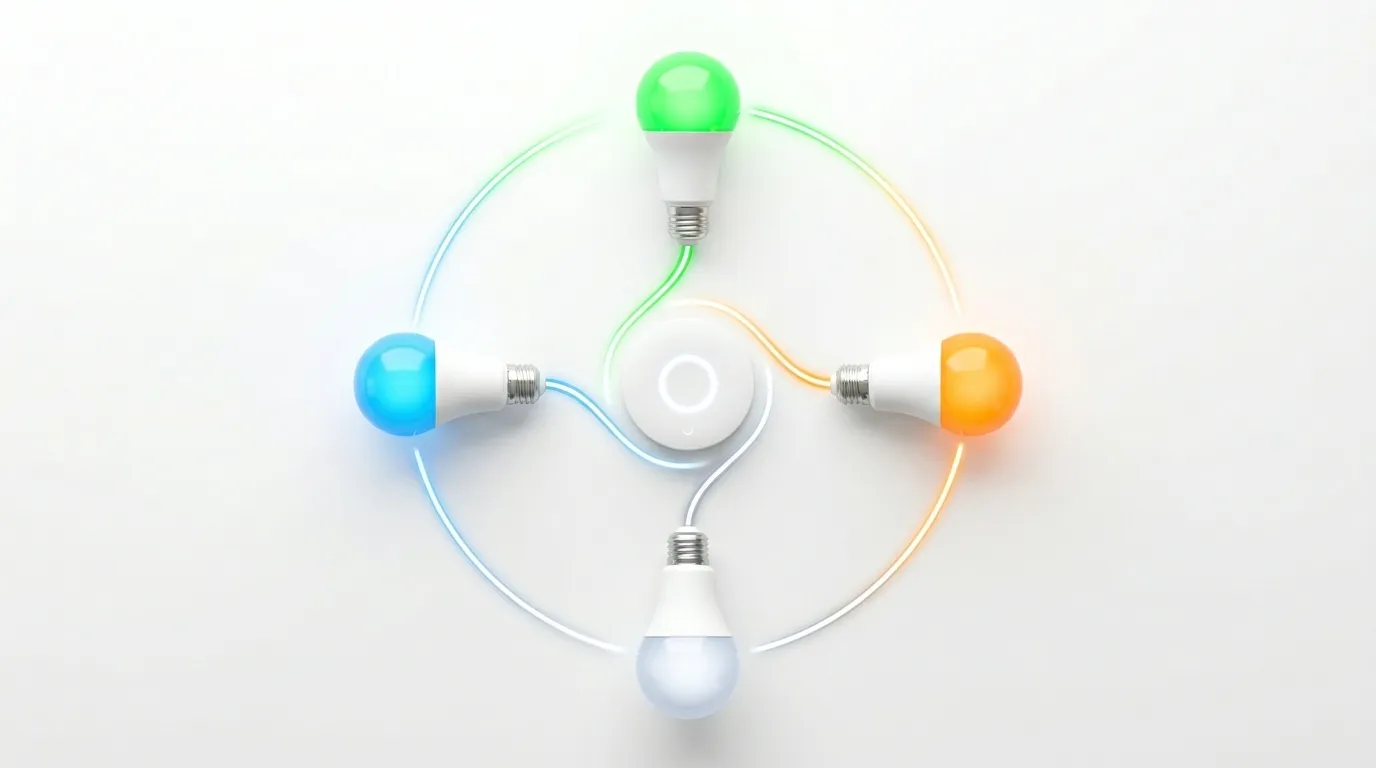
The Internet of Things is a straightforward concept that marketing language has made confusing. Strip it back: IoT is any physical object with a sensor and a network connection. The object can be a thermostat, a streetlight, a shipping container, a hospital bed, or a boiler control unit. The sensor collects data. The network connection transmits it. Something — software, a platform, increasingly an AI model — decides what to do with it.
Think of IoT as the nervous system of a building, a city, or a factory. The sensors are the nerve endings. The network is the spinal cord. The data platform is the brain. For most of the last decade, that "brain" was relatively simple — rule-based logic. If temperature exceeds X, trigger Y. If sensor detects motion, turn on light.
AI changes the brain. Instead of following fixed rules, an AI system learns patterns in the data. It identifies anomalies that a rule-based system wouldn't recognise as anomalies. It predicts future states based on historical data. It makes decisions that require weighing multiple variables simultaneously — the kind of decisions that previously required a human engineer reading a dashboard.
The shift now is toward system-level coordination where lighting, climate, security, and appliances respond to shared context — like occupancy, time-of-day, and energy conditions — rather than operating in isolation. TechBlocks That's the meaningful leap. Not individual smart devices. Environments that think.
The boiler example above isn't a smart boiler. It's a standard boiler with a small, inexpensive vibration and pressure sensor connected to an IoT platform running an anomaly detection model. The AI isn't in the boiler. It's in the cloud platform that watches the data stream and learns what normal looks like — so it can recognise when something stops being normal.
The Scale in 2026: Numbers Worth Knowing
Over 57% of US households are expected to have at least one smart home device by 2026, with the average smart home containing 15 to 20 connected devices — a dramatic acceleration from 28% in 2020. Digitalholics LLC
The global smart home market size is estimated at $133.3 billion in 2026, projected to reach $850 billion by 2040. Roots Analysis
In the UK, the smart home market is projected to reach $12.29 billion in 2026 Fortune Business Insights — smaller than Germany's but growing at comparable rates. The UK's rollout is being shaped significantly by the government's smart meter programme: a new framework introduced in early 2026 obligates energy suppliers to take all reasonable steps to install smart meters in 100% of domestic properties by 31st December 2030. GOV.UK Ofgem implemented tougher smart meter standards from February 2026, with Melissa Giordano, Deputy Director of Systems and Processes, stating: "Smart meters offer customers accurate bills, cheaper tariffs, and real-time energy use tracking." Ofgem
That rollout matters beyond just energy billing. Smart meters are the most widely deployed IoT devices in UK homes — and they generate half-hourly energy consumption data that, in aggregate, tells energy companies and grid operators a detailed picture of household behaviour. When your heating turns on. When you make coffee. When the house is empty. The data governance around this — who can access it, for what purposes, under what consent — is covered under the Smart Meter Data Access and Privacy Framework, a UK-specific regulatory layer that sits above standard GDPR.
That's a significant difference from the US, where smart meter data governance varies by state, with some states offering strong protections and others leaving the regulatory landscape patchy.
Testing It: Building a Useful Smart Home for Under £400
I spent three weeks building and testing a practical smart home setup for a three-bedroom house — not a showroom, not a tech demo, a real family home. The brief: meaningful automation that saves time or money, works reliably, and doesn't require an app for every individual light bulb.
Total budget: £385 ($490).
The setup: a Google Nest Hub (£89/$109) as the central controller, four Philips Hue White bulbs with bridge (£89/$109), a Tado smart thermostat (£149/$189), two smart plugs (£14/$18 each), and a Meross smart power strip with energy monitoring (£35/$44).
Setup took one Saturday afternoon. The Tado thermostat was the most complex — about 45 minutes including fitting, app configuration, and linking to the Google Home ecosystem. The Hue bridge took 20 minutes. The smart plugs were ready in under three minutes each.
What actually changed after four weeks of use: heating costs dropped noticeably because Tado's geofencing turns off the heating when the house is empty — something a manual schedule never handled cleanly. The energy monitoring on the smart power strip revealed that the old TV in the bedroom was drawing 18W on standby 24 hours a day, costing approximately £28/year for nothing. Turning it off at the plug saved that immediately. The smart bulbs in the living room are genuinely used — dimming in the evening without anyone touching a switch, because a simple routine in Google Home does it automatically.
What didn't work as advertised: the Meross strip lost its connection to the router three times in four weeks, requiring a manual reset each time. The Google Home app's automation interface is less intuitive than it should be for non-technical users — several features require navigating to screens that aren't obviously accessible from the main home view.
The honest verdict: a £385 smart home setup delivers genuine, measurable value if you buy the right devices for the right use cases. Smart thermostat first. Energy monitoring second. Lighting control a distant third — useful, but not the priority. Don't start with a smart fridge.
Meet Denise: Why She Returned Her £800 Smart Home Kit
Denise is a 44-year-old primary school teacher in Leeds. In late 2024, she spent £800 on a complete smart home starter kit — multiple ecosystems, smart speakers in three rooms, smart plugs, a video doorbell, and a lighting system that required its own dedicated bridge.
Six months later, most of it was sitting unused. The smart speaker in the kitchen worked. The video doorbell worked. Everything else had become too complicated to maintain — different apps, different ecosystems that didn't talk to each other reliably, automations that stopped working when a firmware update changed something, and a husband who refused to engage with any of it.
"I thought it would just work," she told me. "Like a smartphone works. But it didn't. Every few weeks something would stop and I'd have to figure out why."
Denise's experience is more common than the smart home industry's marketing suggests. A 2024 report from The Times described much smart home hardware as "clever but clumsy," noting that products such as app-controlled devices often cost more than they're worth and deliver little convenience in return. Iotbreakthrough
The lesson isn't that smart homes don't work. It's that ecosystem fragmentation — different devices from different manufacturers running different protocols, controlled through different apps — creates maintenance overhead that erodes the value proposition. The industry knows this. It's why the Matter protocol exists.
Matter: The Protocol That's Supposed to Fix Everything (Mostly)

For years, buying a smart home device meant making an ecosystem commitment. An Apple HomeKit device only worked with Apple Home. A Google Nest device lived in Google's world. If you had one of each, you had two apps, two automations systems, and two sets of incompatible devices — welcome to the smart home compatibility nightmare.
Matter changes this. Matter is an application-layer protocol meaning it defines how devices communicate their capabilities and state to controllers and other devices. A Matter-certified device works with Apple Home, Google Home, Amazon Alexa, and Samsung SmartThings simultaneously — not through workarounds or bridges, natively. The device speaks a common language that every platform understands. TheGeekInsights
The Matter standard, supported by Apple, Google, Amazon, and Samsung, ensures that devices from different brands work together without compatibility issues. A Thread-enabled light bulb can be set up through Google Home, controlled by Alexa, and automated through SmartThings — all without the need for separate hubs. Ththeater
That's genuinely important. But here's the catch.
The way Amazon, Apple, Google, and others implement the specifications sometimes contradicts Matter's product promise, because their approach is neither consistent nor transparent. SmartThings moved rapidly to full Matter 1.5 implementation just weeks after its release. Other platforms remain stuck on version 1.2. Google Home hasn't made generic switches from the first Matter release available to all users. Amazon's Alexa ecosystem doesn't yet support leak sensors. Matter Smart Home
Matter works reasonably well in SmartThings and Apple HomeKit. It works less reliably with Google Home and Alexa. Smart Home Perfected
That's the current honest state of Matter in 2026: a genuinely important standard that meaningfully reduces ecosystem lock-in for new purchases, but whose real-world implementation is inconsistent enough that you can't yet assume a Matter logo guarantees cross-platform compatibility for every feature. Check the specific device, check the specific platform version, and check whether the features you care about are actually in the currently supported Matter specification — not just in a future release.
The trajectory is positive. The present is messy. Don't let either statement alone determine your buying decision.
The Four Ecosystems Compared: Honest Verdicts
Amazon Alexa
Best for: The widest device compatibility in the market, budget-conscious buyers, US households
Amazon Alexa's device support is roughly double Apple HomeKit's, covering 140,000+ compatible devices. It has aggressive Matter protocol adoption and built-in Zigbee hub support in premium Echo devices. Home Auto Central For most people's first smart home experience, Alexa's broad compatibility and relatively low hardware entry cost ($29.99/£24.99 for a basic Echo Dot) make it the easiest starting point.
But there's a catch on privacy. Alexa voice recordings are stored on Amazon servers by default. Manual deletion is required for history removal. Data is used for Amazon advertising profiles. There is no local processing option for most features. Home Auto Central
UK availability: Full. Most Alexa features available identically to US, though some regional skills and integrations differ.
Honest verdict: The right choice for budget-conscious buyers starting out, or anyone with an existing Amazon ecosystem. Not the right choice for anyone placing privacy above convenience.
Google Home / Google Nest
Best for: Android users, Google Workspace households, predictive automation
Google Home's AI automation is arguably the most capable of any mainstream ecosystem — it predicts patterns better than rule-based systems do and handles multi-device routines with less setup friction than competitors. The Nest Hub display is genuinely useful as a home dashboard.
The privacy position mirrors Alexa: cloud-first processing, Google-wide data integration, voice clip storage by default with manual opt-out required. Google Home's Matter implementation remains behind SmartThings and Apple HomeKit, with some Matter device types not yet supported despite the standard having existed for years. Matter Smart Home
Pricing: Google Nest Hub 2nd Gen: £89.99/$99.99. Google Nest Mini: £39/$49. UK availability: Full.
Honest verdict: The best AI-driven automation of any mainstream ecosystem. The weakest Matter implementation. Worth it for Android users already embedded in Google services. Less compelling if you value local processing or cross-ecosystem flexibility.
Apple HomeKit
Best for: iPhone users, privacy-conscious buyers, anyone willing to pay more for local processing
Apple HomeKit offers the most privacy-focused implementation — local processing for camera footage via HomeKit Secure Video, end-to-end encryption for most HomeKit data, and tight Apple Watch and iPhone integration. Home Auto Central When you trigger an automation in HomeKit, it processes locally in your Apple TV, HomePod, or iPad acting as a home hub — it doesn't send a round trip to a cloud server.
HomeKit's Matter implementation is among the most complete of any platform. Matter Smart Home The limitation: device selection is meaningfully smaller than Alexa's, and the premium Apple hardware required to run the ecosystem adds cost.
Pricing: HomePod Mini (required for full local processing): £99/$99. Apple TV 4K (alternative hub): £149/$129. UK availability: Full.
Honest verdict: For iPhone users who care about privacy and are willing to spend more for it, HomeKit is the correct choice. For everyone else, the ecosystem's device limitations and Apple hardware requirement make it a harder sell.
Samsung SmartThings
Best for: Multi-brand households, technical users, Samsung appliance owners
Samsung SmartThings has cemented its position as the most interoperable and device-agnostic ecosystem in the smart home market. Unlike platforms that focus primarily on voice assistants or branded devices, SmartThings acts as a central hub for connectivity, unifying multiple brands and ecosystems under one management framework. Ththeater Its Matter implementation is the fastest-moving of any major platform.
The limitation: SmartThings requires more setup customisation than Alexa or Google Home, and its app experience is less intuitive for non-technical users.
Pricing: SmartThings Hub: £69.99/$69.99. The platform itself is free. UK availability: Full, including Samsung appliance integration not available in all other ecosystems.
Honest verdict: The correct choice for technical users building a complex multi-brand setup, and for Samsung appliance owners who want their washing machine, fridge, and air purifier in the same system. Not the right starting point for someone who wants simplicity.
The Ecosystem Comparison Table
Ecosystem | Best For | Entry Hardware (USD/GBP) | Privacy Default | Matter Implementation | UK Availability |
|---|---|---|---|---|---|
Amazon Alexa | Budget, widest compatibility | Echo Dot $29.99 (£24.99) | Cloud-first; voice data to Amazon | Moderate — improving but inconsistent | Full |
Google Home | Android users, AI automation | Nest Mini $49 (£39) | Cloud-first; Google-wide data merge | Behind — some device types unsupported | Full |
Apple HomeKit | iPhone users, privacy-first | HomePod Mini $99 (£99) | Local processing; end-to-end encryption | Strong — most complete implementation | Full |
Samsung SmartThings | Multi-brand, technical users | SmartThings Hub $69.99 (£69.99) | Mixed — device-dependent | Fastest-moving; first to Matter 1.5 | Full |
Beyond the Home: IoT in Cities and Industries

The domestic smart home market gets the consumer attention. The industrial and urban applications are where IoT is having its most significant real-world impact.
Smart cities: Manchester, Birmingham, and Bristol are among UK cities with active IoT deployments covering traffic management, waste collection optimisation, and air quality monitoring. AI-based predictive control, IoT-enabled sensors, and cloud-integrated monitoring platforms are improving real-time energy optimisation, reducing wastage, and supporting long-term decarbonisation. MarketsandMarkets In Manchester's city centre, smart traffic signals that respond to real-time flow data rather than fixed timing cycles have reduced average journey times through key junctions by measurable percentages. In London, air quality sensors across the city generate data that feeds into the Ultra Low Emission Zone enforcement and expansion decisions — infrastructure decisions made partly on IoT data rather than on periodic surveys.
Predictive maintenance: This is arguably the most economically significant IoT application in 2026. AI-powered systems can determine a facility's patterns and adjust operational parameters accordingly. Insightaceanalytic In manufacturing, embedding vibration sensors in rotating equipment — motors, pumps, compressors — and running their data through anomaly detection models reduces unplanned downtime. The boiler example at the start of this article is a residential version of the same principle used at industrial scale in refineries, food production facilities, and water treatment plants across the UK and US.
Healthcare IoT: Hospital beds that monitor patient movement and alert nurses to falls before they happen. Medication dispensers that track adherence and flag missed doses. Remote patient monitoring devices that stream vital signs to GPs for patients with chronic conditions — reducing hospital readmissions by identifying deterioration before it requires emergency intervention. The NHS has active IoT deployments across all three of these categories, with the pandemic-era expansion of remote monitoring having created infrastructure that's now being extended beyond the acute use cases that justified its initial investment.
Supply chain: Every major retailer and logistics operator in the UK and US now has IoT sensors tracking temperature-sensitive cargo, package location, and warehouse conditions. What's changed in 2026 is the AI layer on top of that data — predictive routing that reroutes shipments around disruptions before the disruption affects delivery windows, rather than after.
The Security Problem Nobody Talks About Enough
Here's what most smart home guides miss: the devices are almost universally less secure than the routers and computers they connect to.
Research presented at RSAC 2026 Conference found that with IoT devices, you cannot set a password in many cases. There is no protection. Enterprises commonly implement security measures such as multifactor authentication, strict password policies, and encryption to protect computers, phones, and cloud services — but IoT devices operate under entirely different, typically far weaker, security standards. Dark Reading
Only 52% of IoT manufacturers in the UK comply with password security provisions. IOT Insider That means nearly half of smart home devices currently being sold in the UK ship with security standards that fall below the minimum threshold required by the UK's Product Security and Telecommunications Infrastructure (PSTI) Act, which came into force in April 2024.
The PSTI Act — which is among the most comprehensive IoT security legislation globally — requires that consumer IoT devices sold in the UK must not use default or easily guessable passwords, must have a public disclosure policy for security vulnerabilities, and must tell consumers how long the device will receive security updates. From 29 April 2024, new UK law means that all smart devices must meet basic cyber security requirements, including stating the product support end date. Think of the support date as a 'use-by' date for your device. National Cyber Security Centre
The US equivalent, the Cyber Trust Mark programme administered by the FCC, is a voluntary labelling scheme rather than a mandatory requirement — meaning US consumers have less regulatory protection than UK buyers.
The practical risk is concrete. Security researchers have demonstrated how smart home devices can be unlocked remotely by exploiting software vulnerabilities or using readily available hacking tools. Unlike traditional lock picking, which requires physical presence and leaves evidence, digital compromise can happen from a distance with no visible signs of tampering. Rolling Out
The attack surface of a home with fifteen connected devices is meaningfully larger than the same home with none — and most of those devices receive far less security scrutiny than the router protecting them.
A Practical Security Checklist for Smart Home Owners
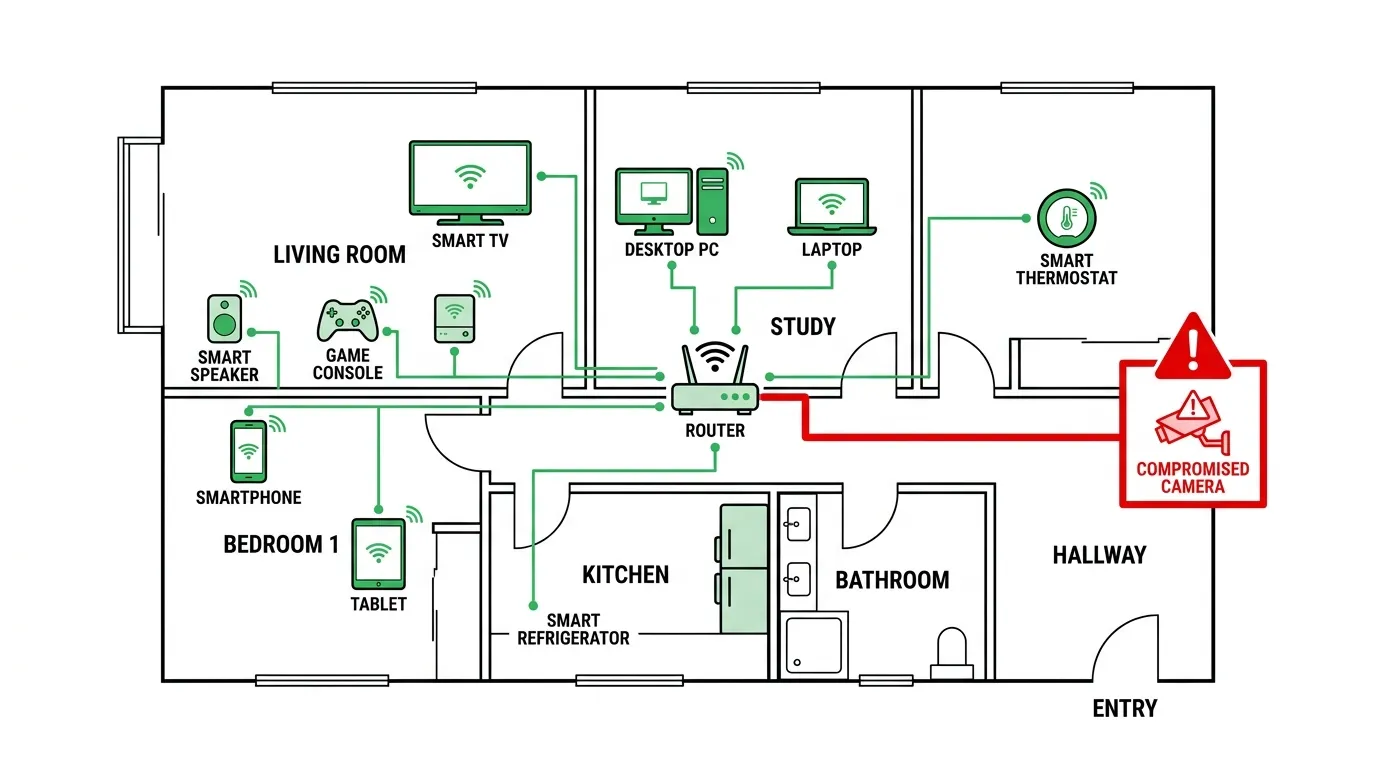
This isn't theoretical. These are the specific steps that matter.
Step 1 — Create a separate Wi-Fi network for IoT devices. Most modern routers support guest networks or VLAN segmentation. Put every smart home device on a network that's isolated from your computers, phones, and tablets. If a smart bulb is compromised, it can't then reach your laptop.
Step 2 — Check the support end date before buying any device. Under UK PSTI rules, manufacturers must disclose how long security updates will continue. Don't buy a device whose support period ends in under three years. When support ends, the device becomes permanently vulnerable to known exploits.
Step 3 — Change default passwords immediately on every new device. Factory passwords for smart home devices are frequently published online by researchers and exploited systematically. This is still the most common attack vector.
Step 4 — Enable automatic firmware updates where available. This is the single most important ongoing security action. Most smart home security incidents exploit known vulnerabilities that have been patched — the patch just wasn't installed.
Step 5 — Audit what data your devices are sending. For UK households: your smart meter data is governed by the Smart Meter Data Access and Privacy Framework — you have the right to control who can access your half-hourly data. For camera-equipped devices: check where footage is stored, whether it's end-to-end encrypted, and whether it's stored in the UK or EU. Apple HomeKit Secure Video stores footage in iCloud with end-to-end encryption. Most camera systems do not.
The Privacy Question: What Your Smart Home Knows About You
Smart home devices collect data that, in aggregate, creates a detailed picture of your daily life. IoT data can be aggregated to create detailed user profiles, tracking daily routines, personal preferences, and even health conditions. When misused, this can lead to invasive surveillance or discriminatory practices. TrustCloud
The specific data landscape, by device type:
Smart speakers (Alexa, Google Home): Process wake-word detection locally; everything after the wake word goes to the cloud for processing. Amazon and Google have both had documented incidents of contractor-reviewed voice recordings from private homes. Both offer opt-out settings, but opt-out is not the default.
Smart cameras: Most consumer camera systems send footage to manufacturer cloud servers, often in the US. For UK households, this triggers GDPR data transfer considerations if the footage contains images of identifiable individuals. Look for cameras that support local storage or HomeKit Secure Video's encrypted iCloud storage.
Smart thermostats: Generate detailed data about home occupancy patterns — effectively, a record of when you're home and when you're not. Tado, Nest, and Hive all have privacy policies governing how this data is used and whether it's shared with energy suppliers or third parties. Check the policy before purchasing.
Smart meters (UK): Governed by the most strong UK-specific privacy framework of any IoT device category. Half-hourly data can only be accessed by third parties with your explicit consent. Contact your energy supplier if you want to review your current consent settings.
Fitness wearables: Among the most sensitive IoT data categories — heart rate, sleep patterns, location history, exercise data. The major platforms (Apple Health, Google Fit, Fitbit/Google) all operate under privacy policies that permit significant data use for product improvement. For health data specifically, UK GDPR treats it as a special category requiring explicit consent for most processing purposes beyond direct service delivery.
The GDPR protects UK and EU residents more rigorously than most equivalent frameworks globally. But GDPR protection only applies where the device manufacturer is subject to it — either by being based in the UK/EU, or by offering services to UK/EU residents. Most major smart home manufacturers fall under GDPR jurisdiction. Many smaller manufacturers of cheap connected devices sold through Amazon Marketplace do not.
How to Build a Smart Home That Lasts: A Five-Stage Framework
If you're starting from scratch or reassessing an existing setup, here's a practical approach that avoids the mistakes Denise made.
Stage 1 — Pick one ecosystem and stay in it. The choice: Alexa if budget and device breadth matter most; HomeKit if you're an iPhone user who values privacy; Google Home if AI automation and Android integration are the priority; SmartThings if you own Samsung appliances or want the most interoperable setup. Pick one. Commit to it for the first year.
Stage 2 — Start with the highest-impact devices only. Smart thermostat — Tado (£149/$189) or Google Nest Learning Thermostat (£219/$249). Energy monitoring smart plugs — Meross or TP-Link Tapo. These two categories have the clearest, measurable financial return. Everything else is incremental.
Stage 3 — Add lighting when the basics work reliably. Philips Hue remains the most reliable smart lighting ecosystem, with Matter support across its range. Budget £89/$109 for a starter set (bridge + four bulbs). IKEA's Tradfri system is a viable budget alternative at roughly half the price.
Stage 4 — Add security devices cautiously. For cameras: choose HomeKit Secure Video or a system with local storage. For smart locks: only buy locks that have received third-party security audits and that explicitly support your primary ecosystem's local processing — a smart lock that requires cloud connectivity to open is a liability, not an upgrade.
Stage 5 — Put IoT devices on their own network. Before you have more than five connected devices, set up a dedicated IoT Wi-Fi network on your router. Most modern routers make this straightforward. It limits the blast radius if any device is compromised.
Conclusion: Three Things Worth Taking Away
The most valuable IoT applications in 2026 are predictive and preventative, not flashy.
The boiler that predicts its failure. The smart thermostat that learns when you're away. The energy monitor that finds the appliance wasting £28 a year. These aren't exciting. They're genuinely useful and they pay for themselves.
The Matter protocol is the right direction but not yet the smooth reality its marketing describes.
It meaningfully reduces ecosystem lock-in for new purchases. Its implementation across the major platforms is inconsistent. Buy Matter-certified devices where available, but verify that the specific features you care about actually work across your specific platform before committing.
Smart home security is genuinely under-resourced.
Nearly half of IoT manufacturers in the UK don't meet minimum password security requirements. IOT Insider Check support end dates before buying. Segment your IoT devices onto a separate network. Enable automatic updates. These aren't optional — they're the baseline for any connected home that handles data you care about.
Your next action: If you own any smart home devices and haven't created a separate IoT network on your router, do that this weekend. It takes approximately 20 minutes, requires no additional hardware if your router supports guest networks (most do), and meaningfully reduces the security exposure of every connected device in your home. After that — check the support end dates on anything you own. If any device is within 12 months of end-of-support with no update path, plan the replacement now rather than after a known vulnerability is being exploited.
The smart home works best when it's doing things you don't notice. The thermostat that adjusts before you feel cold. The boiler that gets fixed before it fails. The light that dims before you reach for the switch. Getting there requires choosing the right starting points, understanding what the devices are actually doing with your data, and securing them properly before the devices outnumber your ability to track them.
The technology is genuinely there. The setup friction is real but manageable. The security risks are specific and addressable. None of this requires technical expertise — just the right sequence of decisions.