
Nobody goes into a relationship planning to fight about money. But most couples do — repeatedly, sometimes bitterly, and often about the exact same things.
Money is the number one issue married couples fight about. In fact, money fights are the second leading cause of divorce, behind infidelity. And the problem isn't usually that couples don't have enough. Couples who fight about money carry roughly $30,000 in consumer debt on average — and 41% of couples with consumer debt say money is what they argue about most.
Talking about money in a relationship is a bit like agreeing on a road trip destination. If one person wants Vegas and the other wants a quiet cabin, someone's going to be miserable no matter how nice the car is. You can have a joint account, a shared mortgage, and matching ISAs — and still be pulling in completely opposite directions if you haven't actually sat down and talked about what you want your money to do.
This article gives you the exact scripts, questions, and frameworks that help. Not vague advice. Actual language you can use tonight.
This article is for informational and educational purposes only and does not constitute personalised financial advice. Always consult a qualified financial adviser before making investment or financial decisions.
Why Couples Struggle to Talk About Money
The honest answer is that most of us were never taught how.
We grew up in households where money was either a source of tension, a taboo topic, or both. We arrive in adult relationships carrying all of that history — different risk tolerances, different ideas about what counts as "too much" to spend, different visceral reactions to debt — and then we're expected to smoothly merge our finances with someone else who's carrying their own set of entirely different stories.
Almost half of Americans in committed relationships — 45% — admit they don't know everything about their spouse's or partner's finances. That's not necessarily deception. Often it's avoidance. Talking about money feels vulnerable. It can feel like an audit. It can feel like a fight before the fight even starts.
But here's the thing — avoidance is what creates the actual problem. The couples who talk about money regularly tend to argue about it less. The couples who don't talk about it tend to discover major financial incompatibilities at the worst possible moments: when a mortgage application is declined, when a credit card statement arrives in the post, when one partner is made redundant and the other has no idea what they actually have in savings.
Most people wait too long to have these conversations.
Meet Priya and Dan: When Hidden Debt Nearly Ended Everything
Take Priya, a 32-year-old marketing manager in Manchester, and her partner Dan, 35, a secondary school teacher. When they moved in together in 2023, they'd been together four years. They felt solid. Ready for the next step.
What Priya didn't know was that Dan had £11,400 on two credit cards — a combination of a redundancy period two years earlier and what he described as "just not paying attention." He'd been making minimum payments. The interest was compounding at 24.9% APR. And he was absolutely terrified to say anything.
"I kept thinking I'd pay it down enough before she noticed," he told me. "But it never got smaller fast enough."
When Priya found out — not from Dan, but from a joint mortgage application that flagged his credit file — it wasn't the debt that nearly ended things. It was the silence.
They got through it. They used a 0% balance transfer card to move £9,000 of the debt and set a joint repayment target of £380 a month. At that rate, the card would be cleared in 24 months — interest-free, saving approximately £2,700 in interest charges compared to staying on the original rate. But the bigger shift was agreeing to a monthly "money date" — a 30-minute check-in where neither partner was allowed to catastrophise or assign blame.
"Once it was on the table, it was actually manageable," Priya said. "It was the not knowing that was unbearable."
The Script Problem: Why "We Need to Talk About Money" Never Works

Many couples never unpack their financial history and beliefs, leading to misunderstandings and resentment. Without open dialogue, secrets fester — and financial infidelity can erode trust just like emotional or physical infidelity.
The phrase "we need to talk about money" triggers defensiveness almost immediately. It sounds like an accusation. It sounds like someone's done something wrong.
Better openers reframe the conversation as forward-looking and collaborative rather than retrospective and accusatory. Here are scripts that actually work:
Opening the first real money conversation: "I've been thinking about where I want us to be financially in five years — can we set aside an hour this weekend to talk through it together? No agenda, no right answers, I just want us to be on the same page."
Bringing up your own debt: "There's something financial I've been putting off telling you, and I don't want to keep doing that. I've got [amount] in [credit card/student loan/etc.] debt. I'm not panicking about it, but I want you to know, and I'd like to figure out a plan together."
Asking about their debt without ambushing them: "Before we start thinking about [mortgage/moving in/big purchase], can we both lay out where we each are financially? I'll go first — I want us both to have the full picture."
Disagreeing about spending without blaming: "I noticed we spent about £800 more than we planned last month. I'm not pointing fingers — I think we might just need a clearer system. Can we talk about what's working and what isn't?"
Setting up a monthly check-in: "What if we did a 30-minute money catch-up once a month? Nothing heavy — just check in on where we are, flag anything coming up, and make sure we're still pointed at the same goals."
The goal isn't to resolve everything in one sitting. It rarely happens that way. The goal is to establish that money is a safe topic — one you can return to regularly, without it becoming a crisis.
The Five Questions Every Couple Should Ask Before Combining Finances
These aren't trick questions. There are no correct answers. But the gap between your answers and your partner's is extremely useful information.
What does financial security mean to you — and when did you first learn that feeling?
This one surfaces childhood money stories quickly. Someone who grew up in a household where money was always scarce will have a fundamentally different relationship with savings than someone who grew up comfortably. Neither is wrong. Both need to be understood.
What's the largest amount you'd spend without checking with me first?
The gap between partners on this question is often enormous — and revealing. One person might say £50. The other might say £500. This single number explains a huge proportion of money arguments.
If we had an extra £5,000 (/ $6,000) tomorrow, what would you want to do with it?
How couples answer this question tells you almost everything about their financial values — and their priorities. One person says "clear the credit card." The other says "finally take that holiday." Neither is irresponsible. But they need to talk.
How do you feel about our financial situation right now — honestly?
Many couples carry financial anxiety they've never actually named. Giving each other permission to say "I'm stressed" or "I feel behind" or "I'm scared about retirement" is foundational to having any productive money conversation at all.
What financial goal would make you feel prouder than anything else in the next three years?
Shared goals are the thing that makes joint financial planning actually work. When both partners can see what they're building toward — a house deposit, paying off debt, a year of maternity/paternity leave without financial stress — the budget becomes a tool for something they both want, not a constraint imposed by one partner on the other.
Joint, Separate, or Hybrid? The Account Question, Settled
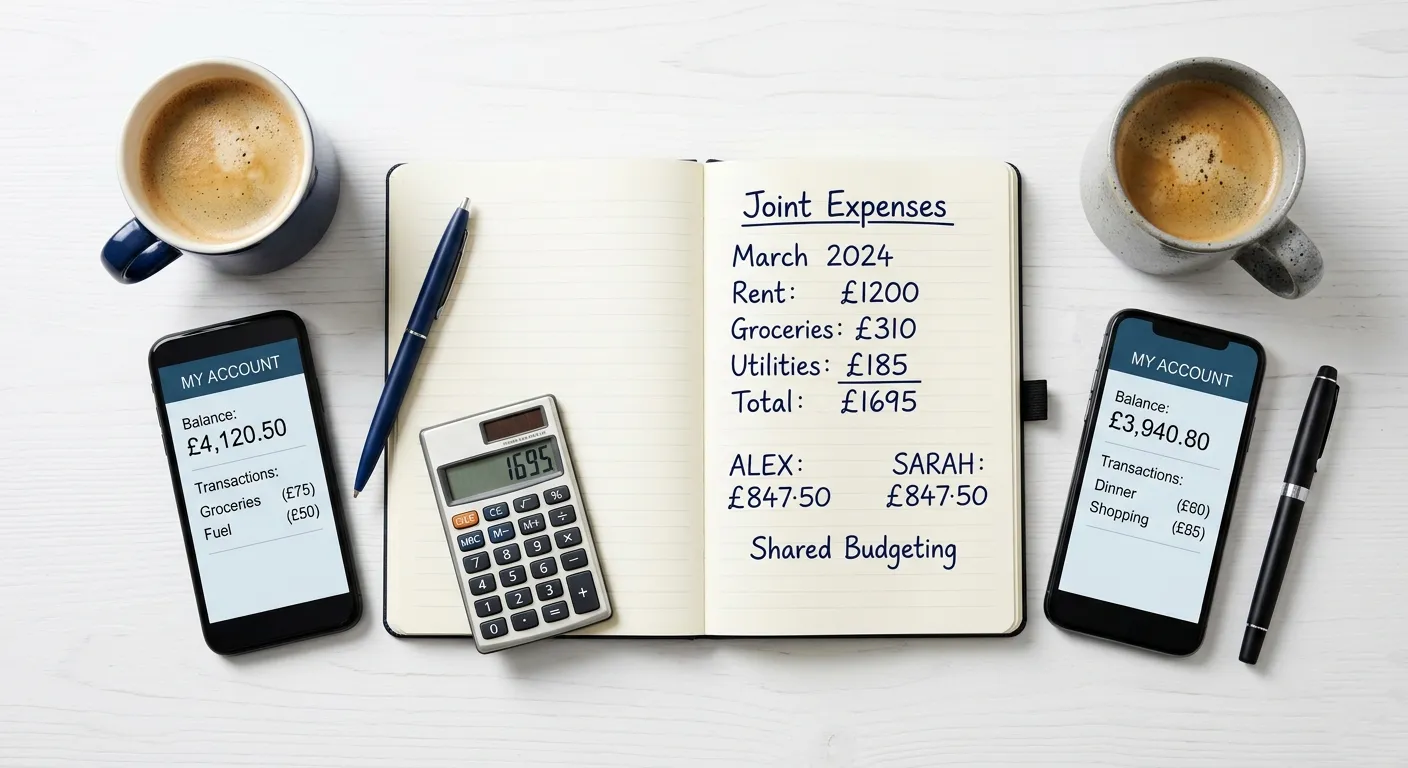
This is one of the most debated topics in couples' finance. The data is more nuanced than most advice acknowledges.
The share of couples without any joint bank accounts rose from 15% in 1996 to 23% in 2023, driven partly by people marrying later — when their finances are already established. At the same time, research from Cornell University published in the Journal of Consumer Research found that couples who pooled their finances were significantly more satisfied in their relationships — and were more likely to stay together — than those who kept money entirely separate.
That's where the conventional wisdom gets complicated.
Structure | How It Works | Best For | Watch Out For |
|---|---|---|---|
Fully Joint | All income goes into one shared account; all spending comes from it | Couples with similar incomes, aligned spending styles, high trust | Loss of individual autonomy; can intensify arguments if one partner earns significantly less |
Fully Separate | Each partner pays their agreed share of joint costs; rest is personal | Couples with very different incomes or debt histories; those who married later | 40% of adults living with partners commit financial infidelity — separate accounts make it easier to keep secrets |
Hybrid ("Yours, Mine, Ours") | Joint account for shared expenses (rent/mortgage, bills, groceries, holidays); personal accounts for individual spending | Most modern couples — especially those with income disparities | Requires agreement on how much goes into the joint account each month |
The hybrid model in practice — US example: A couple in Chicago with a combined household income of $95,000 — one earning $58,000, the other $37,000 — might agree to contribute proportionally to their joint account. The higher earner contributes 61% of shared expenses; the lower earner contributes 39%. On shared monthly costs of $3,500 (rent, utilities, groceries, insurance), that means $2,135 from Partner A and $1,365 from Partner B. Each keeps the remainder in their personal account — no permission required for personal spending.
The hybrid model in practice — UK example: A couple in Bristol where one partner earns £42,000 and the other £28,000, with different Experian credit scores (one at 820, one at 640 — relevant to any future joint mortgage application) might keep entirely separate credit histories while sharing a joint current account for household bills. This protects the stronger credit profile while keeping day-to-day finances transparent. They set a joint savings pot — a separate easy-access account — targeting £1,200/month toward a house deposit.
Honest caveat: The hybrid model works beautifully when both partners' incomes are relatively stable. If one partner is self-employed, freelancing, or in a commission-based role where monthly income fluctuates significantly, fixed proportional contributions can create pressure during lean months. In those cases, a percentage-of-income model — each contributing 40% of whatever they earn that month — often works better than a fixed figure.
What Most Financial Advice Gets Wrong About Couples and Money
Here's what the standard advice misses: it treats the account structure as the solution, when the account structure is just the container.
The couples who fight most about money aren't fighting about which account the mortgage comes from. They're fighting about values. One partner sees spending £150 on a meal as a genuine pleasure and a reasonable treat. The other sees it as reckless and anxiety-inducing. No spreadsheet fixes that. No joint account fixes that. Only the conversation does.
The conventional wisdom says: get your finances organised and you'll fight less. For most couples earning under $70,000 (£55,000) combined, the smarter move is to get your values organised first — and then build the financial structure around those values, not the other way around.
Of couples who share at least one bank account, only 12% said financial issues caused problems with their partner, compared to 15% of those who don't have a shared account. That's meaningful — but it's also worth noting that couples who open a joint account without having the underlying values conversation often find the joint account simply makes existing tensions more visible, not less.
The account doesn't create alignment. The conversation does.
Common Mistakes That Cost Couples More Than Money

Waiting for a financial crisis to have financial conversations. The mortgage application. The job loss. The unexpected bill. Most couples have their first real money conversation during an emergency — which is the worst possible time to establish healthy patterns. Schedule one now. Nothing needs to be wrong.
Treating one partner as the "money person." When one partner handles all the finances and the other is deliberately kept uninformed, it creates a power imbalance that tends to corrode trust over time. Both partners should know the household's net worth, monthly cash flow, pension values, and credit scores — even if only one manages the day-to-day.
Conflating income with contribution. A partner who earns £28,000 and manages the household, does the emotional labour of the relationship, and covers the childcare coordination is not contributing less than a partner earning £42,000. Tying spending autonomy directly to income — without acknowledging non-financial contributions — is one of the fastest ways to breed resentment.
Letting debt stay secret. 40% of Americans in a committed relationship have kept a financial secret — most commonly spending more than their partner would approve of, followed by hiding debt. And 40% of those whose financial infidelity was discovered say they separated or are in the process of separating from their partner as a result. The debt itself rarely ends relationships. The secrecy does.
Assuming "we'll sort it out when we're married." 86% of couples married five years or less began their marriage in debt — double the rate of couples who have been married more than 25 years. Starting a marriage in financial secrecy and hoping it resolves itself is not a plan.
A Monthly Money Date: How to Run One in 30 Minutes

This is the single most practical habit any couple can build. Here's a simple structure:
Minutes 1–5: The Numbers Check Review the joint account balance, credit card balances, and savings balance. No commentary yet. Just numbers on the table.
Minutes 6–15: The Review What did we spend last month that surprised either of us? What came in unexpectedly? Are we on track for the goals we set last month?
Minutes 16–25: The Next Month What's coming up that we should plan for? (Bills, birthdays, car service, tax bill.) Agree on any adjustments to spending before they happen, not after.
Minutes 26–30: The Goal Check-in How are we doing against the bigger goal? (House deposit, debt payoff, emergency fund.) Even one sentence each. The point is to stay connected to the "why."
That's it. Thirty minutes. Same time each month. Most couples who start this report that the actual money arguments — the reactive, reactive ones that happen when a statement arrives — almost disappear within three months.
Conclusion: Three Things Worth Taking Away
The structure follows the conversation, not the other way around.
Whether you go joint, separate, or hybrid matters far less than whether you've talked honestly about what you each want money to do in your life together.
Debt isn't the relationship killer. Secrecy is.
The couples who get through financial difficulty together almost always describe the moment of honesty — however uncomfortable — as the turning point, not the problem.
One conversation isn't enough.
Money conversations aren't events. They're habits. The couples who manage their finances well aren't those who had a brilliant first conversation about money — they're the ones who kept having it.
Your next action: This week, ask your partner one of the five questions above. Not all five — just one. See what comes up. The goal isn't to solve anything immediately. The goal is to establish that money is a topic you can talk about, return to, and get comfortable with over time.
Couples who talk about money regularly tend to accumulate more of it — and argue about it far less. The conversation is free. The cost of not having it isn't.