Starting a business is exciting—but one of the first major decisions founders face is how to fund their startup. Should you grow slowly using your own resources, or raise money from investors to accelerate growth?
This is the core debate of bootstrapping vs fundraising, and the decision can shape your company’s strategy, ownership, and long-term future.
Some of the world’s most successful companies began as bootstrapped startups, building profitability without outside capital. Others scaled rapidly through venture capital and institutional investment, capturing global markets in record time.
For founders in the United States, the UK, Europe, Canada, and Australia, both paths can work. The right choice depends on your business model, risk tolerance, and long-term vision.
This guide breaks down the advantages, risks, and strategic considerations of each funding path so you can choose the one that fits your startup best.
Understanding Bootstrapping
Bootstrapping means building and growing your company using your own resources, revenue, or small personal loans rather than outside investment.
In simple terms, the business funds itself.
Common Bootstrapping Funding Sources

Bootstrapped founders typically rely on:
Personal savings
Early customer revenue
Small loans from friends or family
Credit lines or small business loans
Reinvesting profits into growth
Many early-stage SaaS companies, consulting firms, and e-commerce brands start this way.
Example
A founder launching a niche SaaS tool might spend $5,000–$20,000 (or €4,500–€18,000) building a prototype, acquire paying customers, and grow gradually without outside investors.
Advantages of Bootstrapping a Startup
Bootstrapping offers several strategic benefits that appeal to founders who value independence and long-term control.
1. Full Ownership and Control
When you bootstrap, you keep 100% of the company equity (unless you later issue shares to partners or employees). This means:
You control strategic decisions
You choose your timeline
You define the company culture
In contrast, venture investors usually require equity stakes and board influence.
2. Strong Financial Discipline
Bootstrapped startups must operate efficiently. Because capital is limited, founders focus on:
Revenue early
Lean operations
Product-market fit
Many investors actually prefer companies that have already demonstrated bootstrapped traction.
3. Long-Term Vision
Without investor pressure, founders can prioritize:
Sustainable growth
Profitability
Customer relationships
This is common among European and UK SaaS companies, which often emphasize profitability earlier than venture-backed startups.
4. Lower Risk of Losing the Company
Fundraising often comes with ownership dilution. Bootstrapped founders avoid situations where investors eventually control the majority of shares.
Challenges of Bootstrapping
Despite its advantages, bootstrapping also has limitations.
1. Slower Growth
Limited capital means slower hiring, marketing, and expansion. Competitors with venture funding may:
Outspend you on marketing
Scale faster internationally
Capture market share early
2. Personal Financial Risk
Bootstrapping often requires personal investment. Founders may use:
Savings
Personal credit
Reduced salaries
If the startup fails, the founder absorbs the financial loss.
3. Limited Resources
Bootstrapped startups may struggle with:
Hiring experienced talent
Building complex technology
Expanding into multiple markets
For capital-intensive businesses, this can be a major constraint.
Understanding Fundraising for Startups

Fundraising means raising external capital from investors in exchange for equity or ownership in the company. This capital is used to accelerate growth, product development, and market expansion.
Common Startup Funding Sources
Typical fundraising paths include:
Angel investors
Venture capital firms
Startup accelerators
Corporate investors
Crowdfunding platforms
In the United States and Europe, venture-backed startups often raise multiple funding rounds such as:
Pre-seed
Seed
Series A
Series B and beyond
Each round involves selling additional shares of the company.
Advantages of Fundraising
For many startups, raising capital unlocks opportunities that bootstrapping cannot easily support.
1. Faster Growth
Investment capital allows startups to scale quickly. Funds may be used for:
Hiring engineers or sales teams
Product development
International expansion
Marketing campaigns
A venture-backed company might raise $1M–$5M (or €900k–€4.5M) in early funding to accelerate growth.
2. Access to Expertise and Networks
Experienced investors bring more than money. They often provide:
Strategic advice
Industry connections
Hiring support
Introductions to future investors
Top venture capital firms often help startups scale globally.
3. Competitive Advantage
In fast-moving markets like AI, fintech, or biotech, speed matters. Fundraising allows startups to:
Launch faster
Build larger teams
Expand globally sooner
Many Silicon Valley startups follow this strategy to dominate new markets.
Risks and Trade-Offs of Venture Capital
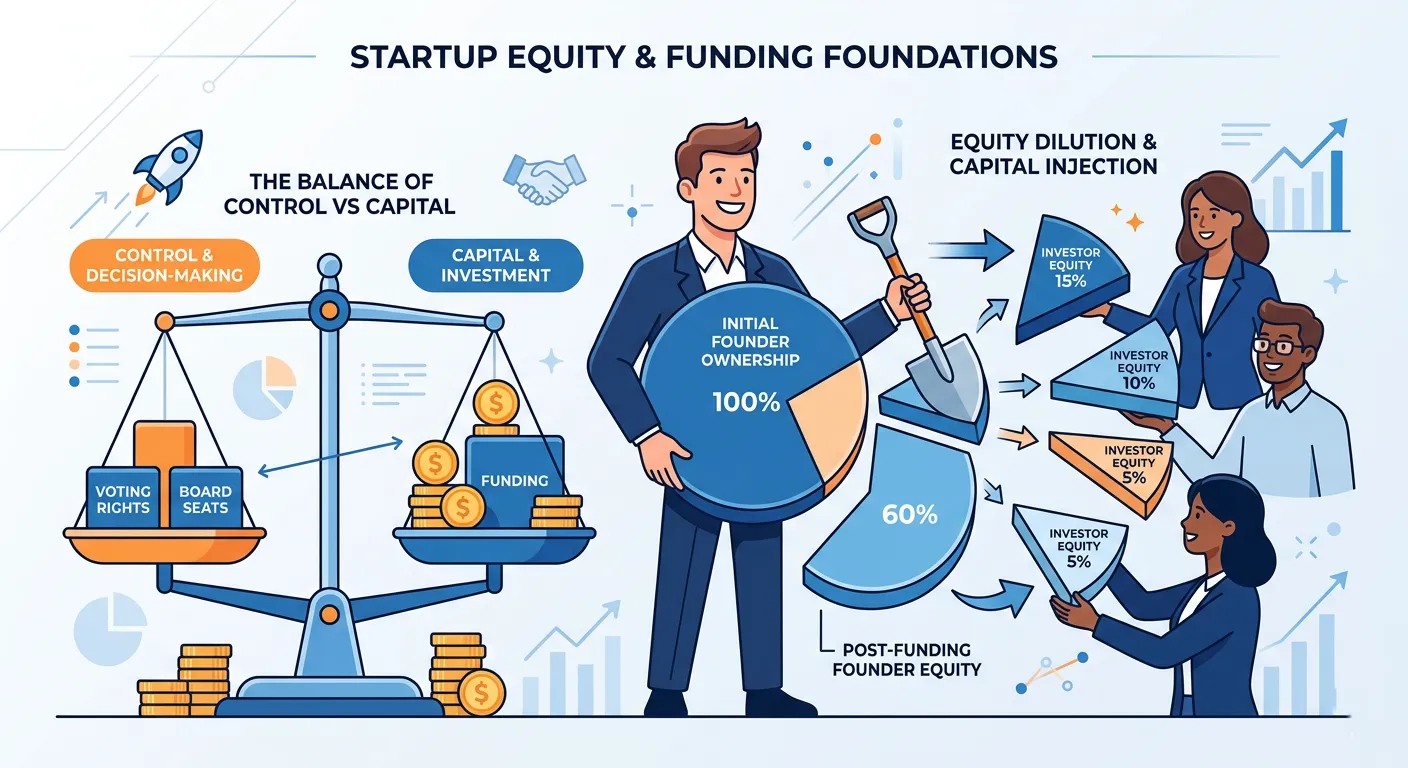
While venture funding can accelerate growth, it also introduces significant trade-offs.
1. Equity Dilution
Each funding round reduces the founder’s ownership. Example scenario:
Founder starts with 100%
Seed round reduces ownership to 80%
Series A reduces it to 60%
Later rounds may drop it below 40%
Investors expect returns, which means they influence key decisions.
2. Pressure for Rapid Growth
Venture-backed startups must pursue aggressive expansion. Investors typically expect:
10x returns
large exits
acquisitions or IPOs
This can create pressure for hypergrowth, even if the business could succeed more slowly.
3. Loss of Strategic Control
Investors may require:
board seats
voting rights
veto power over major decisions
Founders may no longer have complete control over the company’s direction. Choosing between bootstrapping vs fundraising requires evaluating your startup’s goals, industry, and growth potential. Here is a practical framework to help founders decide.
1. Evaluate Your Business Model
Bootstrapping works best when:
Revenue can start quickly
Development costs are low
Customer acquisition is affordable
Examples:
SaaS tools
consulting businesses
niche e-commerce
Fundraising is often necessary when:
Development costs are high
the market opportunity is large
growth must be fast to win
Examples:
AI platforms
biotech startups
marketplace platforms
2. Consider Market Timing
In competitive markets, speed matters.
If multiple startups are racing to solve the same problem, venture capital may provide the resources needed to scale quickly.
In contrast, niche markets often allow slower, sustainable growth.
3. Define Your Personal Goals
Ask yourself:
Do I want full control?
Am I comfortable sharing ownership?
Do I want a large exit or steady profits?
Bootstrapped founders often prioritize independence, while venture-backed founders pursue rapid scale and large exits.
4. Assess Your Risk Tolerance
Bootstrapping concentrates financial risk on the founder. Fundraising spreads risk across investors but introduces accountability and pressure. Both paths require commitment, but they involve different types of risk.
Hybrid Approach: The Best of Both Worlds
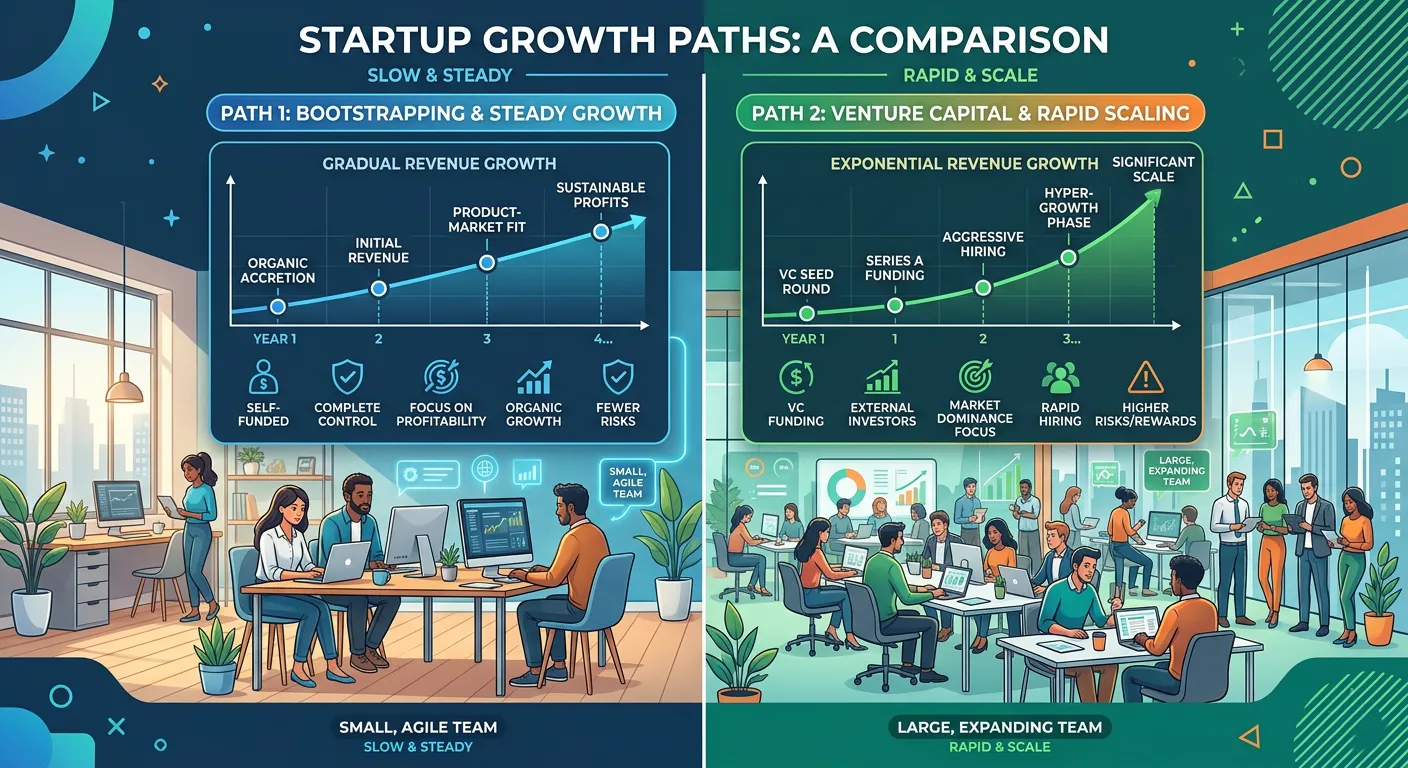
Many modern startups use a hybrid strategy. They begin by bootstrapping to build traction and later raise capital when growth opportunities appear. This approach provides several advantages:
Higher company valuation
Better negotiating power with investors
Proof of product-market fit
For example: A startup might bootstrap to $50,000 monthly revenue before raising a $2M seed round to expand internationally. This strategy is increasingly common among startups in the US, UK, and European tech ecosystems.
Common Mistakes Founders Make
Choosing the wrong funding strategy can slow a startup’s progress. Here are common mistakes to avoid.
Raising Money Too Early
Some founders pursue venture capital before validating their product. Investors typically want:
working products
early customers
clear market demand
Bootstrapping When the Market Requires Speed
In fast-moving industries, slow growth may allow competitors to dominate the market.
Ignoring the Cost of Capital
Investor funding isn’t free. Equity can become extremely valuable later. Giving away 20–30% ownership early can be costly if the company succeeds.
Conclusion: Choosing the Right Path for Your Startup
The debate between bootstrapping vs fundraising isn’t about which path is better—it’s about which one fits your startup.
Bootstrapping offers:
independence
ownership
sustainable growth
Fundraising offers:
speed
resources
large-scale opportunities
For many founders, the ideal strategy is bootstrapping first and raising capital later, once the business has traction and stronger negotiating power.
The key is to align your funding strategy with your business model, market opportunity, and personal goals.
Before choosing a path, take time to analyze your startup’s economics, industry dynamics, and long-term vision. The right decision early on can shape the trajectory of your company for years.